Watch the video first
See the robot in action
The provided translation and timecodes were applied. The statements in the video are the explanations of the featured person and the manufacturer at the time of production. This is a different device from HAIRO. Statements about function and effects are the explanations of the manufacturer and the featured person at the time.
Even when a robot helps, doctors are still needed.
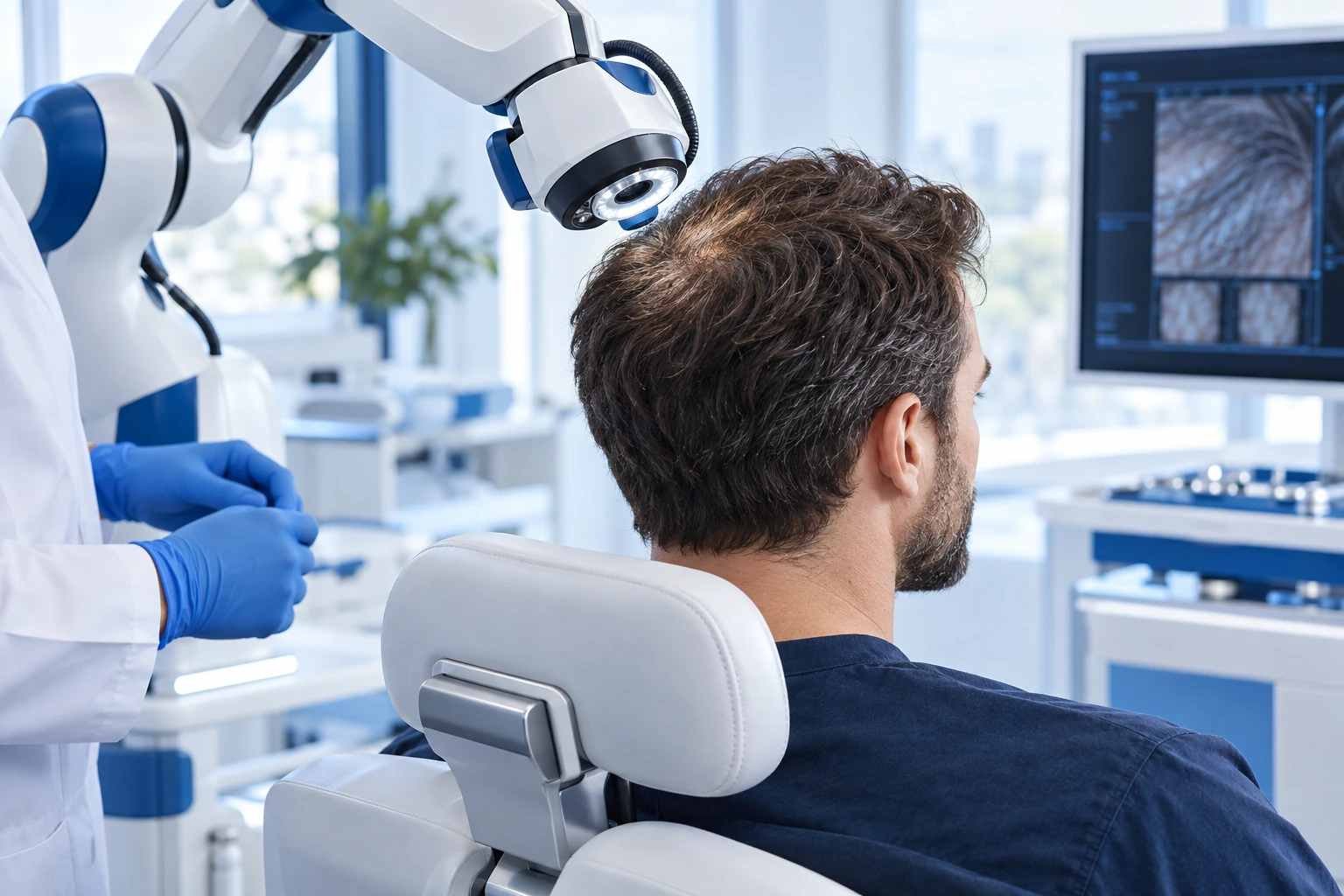
Robots help with some tasks in hair transplantation. Where and how much to harvest, and what hairline to create, still depend heavily on the medical team's judgment.
Even when a robot lends a hand, the surgical plan is still needed separately.
The work of handling tiny follicles thousands of times
Follicles are small and delicate. Robots can help with repetitive tasks using cameras and programs. Which tasks are automated depends on the equipment and version. Evidence

If harvesting is accurate, will it always grow well?
It is not decided by that alone. Storage after harvesting, the transplant process, and the condition of the scalp also matter. "Using a robot" and "good engraftment" are different matters. Evidence
One part of the surgical process
Results to check after transplantation
Can AI replace the doctor?
You cannot say that doctors are no longer needed just because of the equipment introduced so far. Assessing the patient's condition, making the plan, and responding if problems arise during surgery still remain the doctor's roles. Evidence
Remember This
Robots help with some tasks in hair transplantation. Where and how much to harvest, and what hairline to create, still depend heavily on the medical team's judgment.
- A robot is a tool that assists surgery.
- You cannot judge the result by the single factor of whether a robot was used.
- Check the doctor's plan and role together, not just the equipment name.
Continuing the story a little further
Let's look at the background a bit more
Robotic hair transplantation: how much can we entrust to it?
Is the October 15 news an announcement that introduction is complete?
The HAIRO news reported on October 15, 2026 is partnership news for a business in Korea. It states that MetaLabs and Puncture Robotics will pursue research and development, approval, evaluation, and commercialization. It should not be read as meaning robots are already commonly used in Korean hospitals or that domestic approval has been completed. [RF1]
If we divide hair transplantation into three scenes,
The first step is harvesting follicular tissue from the donor area, such as the back of the head; the second is placing it in the needed areas with a set direction and spacing; the third is the process by which the transplanted tissue survives and grows. Whether the camera finds follicles well, whether they are harvested well, and whether they grow well after transplantation must each be confirmed. The core of the HAIRO report is harvesting using AI image recognition and a robotic arm. The "95% accuracy" in the article cannot be restated as "95% of grafts engraft." [RF1][RF2]
Questions to ask before speed
Robots may reduce a doctor's fatigue during repetitive motions. However, each person's scalp, hair angle, hair thickness, and follicle condition differ. We must also look at which stage of surgery the robot helps with and what kind of help it gives, as well as tissue damage and the condition of the donor area. The ARTAS video below is material for understanding how the robot moves; it is not the same device as HAIRO. [RF2][RF3]
The difference between robots already in use and this news
Robotic hair transplantation is not a concept that has appeared for the first time this time. ARTAS is an existing device that went through the 510(k) process of the U.S. FDA in 2011. What is new about this HAIRO report is less the concept of a robot itself and more that it promotes domestic research, evaluation, and commercialization centered on a device from another developer.
Source: FDA ARTAS K103428 document · Domestic agreement report RF1 · ARTAS comparison study RF2. The existing U.S. device document is not the basis for HAIRO's domestic approval.
There is already an existing robot, so why is this news new?
Robotic hair transplantation itself is not news of a first appearance. The 2011 FDA document for ARTAS in the U.S. already exists. The October 15, 2026 article is news about a new domestic partnership and business push related to HAIRO. A new agreement or introduction plan is different from proof that clinical performance is better than existing equipment. The report alone also does not show that domestic approval or the start of treatment has been completed. [RF1]
Which should we compare: speed, fatigue, or results?
These three must be measured separately. Even if shortening harvesting time or easing the repetitive burden on medical staff is an advantage, that alone cannot replace engraftment rate and aesthetic improvement. For patients, what matters is how many follicles usable under the same conditions were secured, and how long-term engraftment, scarring, and side effects turned out. The 13-person ARTAS comparison study also reported harvest yield, transection rate, discard rate, and follow-up results separately. [RF2]
What is the first data to check for new equipment?
First check the approved scope of use, the steps it actually automates, the hair characteristics of the target patients, and clinical data compared with surgery by experienced surgeons. It also matters what the precision figure presented by the manufacturer actually measured. Mechanical positional error or harvesting accuracy cannot be restated as the patient's final engraftment rate. Avoid ranking numbers from different devices side by side without test conditions. [RF1] [RF2]
Read a Step Further
We have summarized the study population and methods, what the results mean, and the questions that remain unanswered.
Study design
The 2024 ARTAS comparison paper is a single-center study that divided the donor areas of 13 Chinese men into left and right. Comparing within the same people reduced individual differences, but the scale is small. ARTAS harvesting was performed first, and the device, punch, and operator conditions also affect how the results should be interpreted. It is not a HAIRO trial. [RF2]
What was measured
Harvest yield was 82.05% for ARTAS and 90.03% for comparison FUE, with no statistically significant difference. Discard rate was 10.71% vs 5.46%, showing a difference, while transection rate was 13.17% vs 13.96%, with no statistically significant difference. All of these are harvesting-stage indicators and do not indicate long-term engraftment rate. [RF2]
What to check in news reports about new equipment
HAIRO's 95% and 0.01 mm are figures announced by the company. We need more material to check what was measured, the denominator, the comparison device, the independence of evaluators, and the follow-up period. The article alone cannot determine long-term growth or domestic approval status. [RF1]
Answering Questions With Evidence
When robots come in, what does the doctor do?
Which steps are automated depends on the device and generation. The core of the early ARTAS is harvesting assistance: a camera identifies hair position and direction, and the robotic arm aligns a punch to separate the tissue around follicles. This does not mean it replaces donor-area assessment, anesthesia, hairline design, follicle selection and storage, or the entire transplant process. The doctor selects suitable patients, checks settings and progress, and responds to situations such as damage or bleeding. Check which steps are automated and how much the doctor can adjust before looking at the device name. FDA early ARTAS document ↗ [RF2]
Are results better with a robot than with hand-performed surgery?
The material introduced so far cannot support that conclusion. The 2024 study split the donor areas of 13 men into left and right and compared ARTAS with manual FUE by an experienced operator. There was no statistically significant difference in overall hair transection rate or in 12-month satisfaction, and the proportion of follicles discarded as unusable was higher on the robot side. Because the study is small, a no-difference result should not be taken as full equivalence. Accuracy, speed, the doctor's fatigue, and final engraftment and naturalness are different evaluation items. [RF2]
More Detail on the Principles and Cases
We now connect the questions that remain after the short answer to actual research and cases.
How does a robot recognize hair?
A person looks at the magnified scalp to judge the direction in which hair grows and aligns the tool. An image-based robot has a computer analyze the information gathered by the camera and links those coordinates to the robotic arm's movement. Put simply, it is a method that connects, inside the machine, the step of finding with the eye and the step of moving the hand. However, it is not guaranteed that the path of hair above the skin visible to the camera and the follicle beneath the skin will always be exactly the same. Automated motions must also be evaluated while checking actual tissue damage.
The core of harvesting is separating the surrounding tissue before pulling.
FUE separates the follicular tissue area with a small cylindrical tool called a punch and harvests it. When manual or motorized tools are used, the doctor adjusts the position and entry direction. The robotic method uses image information to automate part of this repetitive motion. Inserting the punch alone does not secure healthy grafts. The separated tissue must be retrieved, its condition checked, and then connected to storage and transplantation. That is why we distinguish the number of machine actions from the number of grafts actually usable.
What it does depends on the model and its documents, not the product name.
The FDA document for early ARTAS describes it as a device that helps recognize and harvest follicles under a doctor's instruction, using image guidance. The transplant step in this document is the conventional manual method. We must not mix functions of later generations into this early document, nor assume that motions seen in ARTAS videos also exist in HAIRO. We must check model by model whether it is a harvesting robot, whether it creates the holes for transplantation, or whether it even performs the actual insertion. The HAIRO report alone cannot say that all surgical steps are automated.
Dividing the work of humans and robots
In treatment, we first look at the cause and progression of hair loss and plan how much to transplant and which areas to allocate resources to. During harvesting, we also check tissue condition and donor-area distribution, and must change the plan if problems occur. A robot's ability to repeat set tasks and a doctor's judgment in building a long-term plan for the patient are not the same function. This distinction is not meant to diminish the value of robots; it is a starting point for precisely identifying where they help.
When comparing, we must set the same finish line.
For example, even if the camera recognizes the target well, the usable tissue decreases if follicles are damaged during the actual harvesting process. Conversely, even if harvesting time is shortened, we cannot guarantee that total surgery time shrinks by the same amount. This is why we look separately at recognition rate, harvest yield, transection rate, discard rate, long-term growth, and patient satisfaction. The 13-person ARTAS study shows that these indicators may not move in the same direction. It is more useful to ask under which conditions and for which tasks one performs better than to ask whether a robot or a human wins.
Read and Look Together
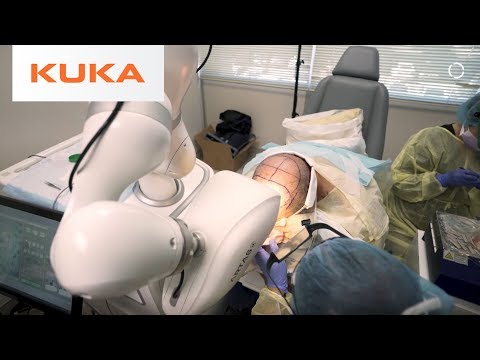
KUKA Group · ARTAS iX Introduction Video · Released 2018
What does the video show?
Officials from Restoration Robotics and KUKA introduce the development background of ARTAS iX and how the robot assists with follicle harvesting and transplantation. They explain that maintaining precision and consistency while handling thousands of tiny grafts is an important challenge.
What features does it explain?
The speakers discuss follicle harvesting, creating recipient sites, the system's insertion function, and control of harvest spacing and density. They then introduce the miniaturization of the KUKA robot platform, monitoring of joint force and torque, and the collaboration experience of the two companies. Which functions are supported must be checked separately for each device and generation.
Is it the same device as in this HAIRO news?
No. This video is a manufacturer's material introducing the earlier ARTAS iX. The advantages shown in the video must not be taken as results of an independent comparison test, nor carried over as evidence of HAIRO's performance or domestic approval. Under the video in this article, you can also view the Korean translated subtitles and docent commentary together.
Korean summary based on the original text · Information checked 2026.10.20
Money Today · 2026.10.15 · Corporate partnership report
What new information was announced?
This is partnership news in which MetaLabs and Puncture Robotics will pursue domestic research and development, approval, evaluation, and commercialization centered on HAIRO. It is not an announcement that the concept of robotic hair transplantation was invented for the first time.
How should we read the performance figures in the article?
The article presents figures such as 95% accuracy and 0.01 mm, which the company claims for AI image recognition and harvesting with a robotic arm. We need to check what these figures measured and under which conditions, and harvesting-related accuracy cannot be read as the post-transplant engraftment rate of hair.
What can we know from this article?
We can confirm the agreement and the direction of promotion, but from the report alone we cannot conclude that approval, sales, or the start of treatment in Korea has been completed. Nor does this article provide direct comparative evidence that the final outcome is better than ARTAS or a skilled surgeon's manual surgery under the same conditions.
Korean summary based on the original text · Information checked 2026.10.20
Dig Deeper Through the Sources
Check the nature of the material and the scope for reading it.
MetaLabs and China's Puncture Robotics announced an MOU for R&D, approval, clinical and usability evaluation, and commercialization of HAIRO. The core function explained in the report is AI image recognition and harvesting of follicles using a robotic arm. This article conveys the company's announcement; it is not material announcing domestic approval or the actual completion of introduction. [RF1]
The harvesting accuracy of 95% and precision of 0.01 mm in the article are figures announced by the company. We could not secure material in this investigation that independently verified the measurement conditions and definitions. Changing it to "95% will grow" or "surgical success rate of 95%" must not be done. Camera recognition, harvesting success, tissue transection, discard, and long-term growth outcomes are different evaluation items. [RF1·RF2]
The 2024 paper evaluated ARTAS and comparison FUE by dividing the donor areas of 13 Chinese men into left and right. The discard rate showed a difference, 10.71% vs 5.46%, but there was no statistically significant difference in transection rate, 13.17% vs 13.96%. This is an example of separating evaluation indicators rather than concluding "the robot is better or worse" from a single number. This study is not a HAIRO study. [RF2]
Detailed explanations and the study's conditions and limitations can be read in the body of this article and the research notes. The original text can be checked through the source link. Video commentary is displayed below the player.
Performance and China registration are claims made in the report. Do not extend them to completed domestic approval or sales, or to an engraftment rate.
13 people, under specific age, sex, and equipment conditions. It cannot be generalized to all robots or to HAIRO.
This is background guidance to help understand surgery and tools, not a comparison test of a specific device.
Information checked as of October 20, 2026