
Watch the video first
Real case of hair follicles received from another person
Alex Ford, who had too little donor hair after cancer treatment, received follicles donated by his identical twin brother, Austin. This is an exception, unlike transplants between ordinary friends.
The 21 Korean translations provided to us and the timecodes were applied. The statements in the video are the explanations of the featured person and reporter at the time of the broadcast, and the docent commentary is a separate explanation by the editorial team. This is a 2012 procedure case introduced by Charles Medical Group, separate from the 1988 paper in this article. It is a case from that institution and is not a procedure case of Banal Plastic Surgery.
View original NBC report video ↗ · Case description from the performing medical institution ↗
You cannot easily borrow a friend's follicles
Receiving a friend's follicles and planting them is not a common hair loss treatment, because your body can reject another person's tissue. There is a special case of identical twins.
Evidence · [TF1] [TF2] [TF3] [TF4]
No matter how full your friend's hair is, it cannot easily be shared.
Why can't they be received the way blood is donated?
Follicles are living tissue. Your body may see another person's tissue as foreign and attack it. This is called "immune rejection." Having the same blood type does not solve this problem. Evidence
It uses hair that has already grown.
It moves living follicles.
But why was it possible for twins?
There is a case in which identical twin brother Austin shared follicles with Alex, who lost his hair after cancer treatment. It is an exceptional story between identical twins, who are genetically very close. Evidence
Will the day come when we can multiply and use our own follicles?
Research on growing follicles and making hair grow again is ongoing. But hair growing in animal studies and a person being treatable at a hospital are different things. Evidence
Remember This
Receiving a friend's follicles and planting them is not a common hair loss treatment, because your body can reject another person's tissue. There is a special case of identical twins.
- Receiving a friend's follicles is not a common hair loss treatment.
- Transplants between identical twins are a special exception.
- If you lack follicles, you should first consult about the condition of your donor area and the options available.
Evidence · [TF1] [TF2] [TF3] [TF4]
Continuing the story a little further
Let's look at the background a bit more
Can we plant a friend's full head of hair?
What is planted is not only hair
Could the problem be solved by receiving a small amount of hair from a friend with a full head of hair? For a wig it is a conceivable idea, but in hair transplantation the situation is different. What is moved in surgery is not hair that has already been cut, but living tissue including follicles. Your body may recognize another person's tissue as foreign. Being the same blood type or being family does not make this problem disappear. [TF1][TF2]
Having exceptions and being possible for everyone are different things.
The medical literature includes special cases of transplantation between identical twins and of hair received from the same donor after bone marrow transplantation. In the former, the genetic background is special, and in the latter, the immune environment differs from that of typical patients. These cases show "what can happen when conditions differ," but they are not evidence that a general hair loss patient can receive a friend's follicles. [TF1][TF2]
So can I expand my own follicles?
Instead of borrowing someone else's follicles, research is exploring a direction of making more follicles from one's own cells. The difficult part does not end with getting hair to grow once. The follicles must maintain the cycle of regrowth after shedding, produce the desired thickness and direction, and work safely. RIKEN's 2021 announcement is a study that found conditions for repeated regeneration using cultured mouse cells. It did not announce a treatment already available for people. [TF3][TF4]
Read a Step Further
We have summarized the study population and methods, what the results mean, and the questions that remain unanswered.
The role of case reports
The reports of transplantation between identical twins and of hair transplantation from a bone marrow donor are each cases under special immune conditions. A small number of cases can explain possibilities, but they are not enough to estimate success rates or safety for general patients. They should not be read as justification for immunosuppressive treatment for cosmetic purposes. [TF1][TF2]
The 2021 RIKEN study
This is a preclinical study using follicle cells from mouse fur and whiskers. The researchers explored culture conditions and evaluated the repetition of the regeneration cycle. The key is not just an increase in cell numbers, but conditions that maintain the ability to repeatedly produce hair. We distinguish between the "next steps" stated at the time of the announcement and current clinical availability. [TF3]
Questions that remain
It must be confirmed whether the results can be reproduced in human cells, whether hair grows long enough after transplantation, whether shape and direction can be controlled, and whether safety and production quality can be kept consistent. The 2025 review of regeneration research also summarizes the research landscape; it is not proof of treatment approval or clinical efficacy. [TF4]
Answering Questions With Evidence
Doesn't it solve the problem if you receive follicles from a friend with a full head of hair?
Ordinary hair transplantation is surgery that moves your own follicles. Another person's follicles contain cells that the immune system may recognize as foreign tissue, so they do not take simply because the hair color and thickness are similar. There are reported cases under special immune conditions, such as between identical twins or after bone marrow transplantation, but these cannot be applied to an ordinary transplant between friends. Accepting the burden of immunosuppression to obtain hair for cosmetic purposes is not a general alternative. [TF2]
Then what options are there for people who lack donor hair?
The present and the future must be separated. Currently, the starting point is evaluating your remaining donor hair and the extent and progression potential of your hair loss, then adjusting the priority of the area and density to be transplanted. There are studies and clinical reports using beard and body hair, but they differ from scalp hair in thickness, curl, and growth cycle, so they are not the same material for everyone. Research that expands follicles by culturing them aims to overcome this limitation, but the RIKEN experimental results introduced in this article should not be read as a treatment currently available to people. [TF4]
More Detail on the Principles and Cases
We now connect the questions that remain after the short answer to actual research and cases.
Why does organ transplantation come up in a discussion about hair?
Attaching cut hair and transplanting follicles are different. The former uses material that has already been made, while the latter moves living tissue that continues to produce hair to another location. If the tissue comes from someone else, one must also consider how the immune system would react. So the question "My friend has a full head of hair, so if I take a little, wouldn't that work?" becomes the question "Can my body accept my friend's tissue?"
Real exception 1 · Case report of transplantation between identical twins
In 1988, a case of hair transplantation between identical twins was published. This case shows that the conditions for transplantation cannot be explained by the everyday distinction between different people. However, identical twins differ genetically from ordinary siblings or friends. This special report cannot be used to say that it would work the same way between family members in general.
Real exception 2 · Hair from the same donor after bone marrow transplantation
There is also a case in which a bone marrow transplant recipient received hair from the same bone marrow donor. This is a story of a person whose immune environment had already changed through a bone marrow transplant. It does not mean that such an immune state can be created anew to solve hair loss. What is interesting about the case is not only the outcome that it was "possible," but also what conditions differed from those of a typical patient.
So what about my beard or chest hair?
A distinction must be made between receiving tissue from another person and moving it from another part of your own body. A 2013 observation of 35 men found that beard and body hair transplanted to the scalp retained the color, curl, and thickness of their original site. This means that changing the origin of follicles does not make all of them into the same hair. Even though there is potential to broaden donor resources, you must consider where and how much to mix them, along with aesthetic harmony. This study is not evidence that all body hair is suitable for everyone.
The number 122 should be read together with the participation conditions
A 2016 report from one institution on body hair transplantation selected in advance 122 patients who had sufficient body hair. Of these, 79 responded to the survey, and satisfaction was assessed on average 2.9 years after the last surgery. Therefore, it cannot be read as a randomized trial that objectively compared graft survival across all 122 patients. The patients' selection conditions and the existence of people who did not respond are important for interpreting the results. It is also not material introduced to mean that our hospital offers the same procedure.
Research on increasing follicles addresses another problem
Transplanting one's own body hair is an approach that rearranges the resources one already has. Research regenerating follicles from cells asks whether the resource itself can be increased. In this case, you need to confirm separately whether a hair can be produced once, whether it regrows after shedding, and whether it is maintained over the long term in human scalp. RIKEN's mouse study addresses the important question of repeated growth, but it must be distinguished from a completed human treatment. "Borrowing from others," "bringing from another part of your body," and "creating new" look similar, but the challenges each must solve are different.
Read and Look Together
RIKEN · 2021.02.10 · Research institute announcement
What research was this?
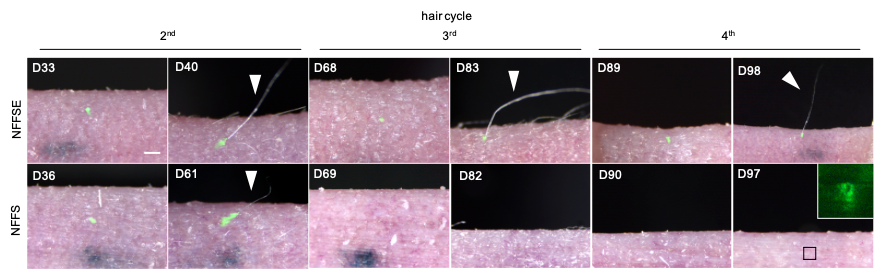
What matters in follicle regeneration is not merely producing hair once, but maintaining a cycle of growing, shedding, and growing again. The researchers cultured cells obtained from the body hair and whiskers of mice and compared 220 conditions, finding conditions that increase follicle stem cells and maintain the ability to regenerate repeatedly.
What were the results?
Under the NFFSE culture condition, which combines collagen and five factors, 81% of the regenerated follicles showed three or more growth cycles. The researchers also confirmed that a cell population marked by CD34, CD49f, and Itgβ5 is important for repeated regeneration. This means that simply increasing the number of cells and maintaining the ability to keep producing hair are different things.
Can it be applied to humans right away?
The key functional validation in this announcement is animal experimentation. It does not mean the same results and safety were confirmed in human hair loss areas, nor that rejection disappears when someone else's follicles are received. At the time of the announcement, the research team explained that they were seeking external collaborators to develop clinical application together. One should read the difference between currently available general hair transplantation and future follicle regeneration research.
Korean summary based on the original text · Information checked 2026.10.20
Chu et al. · Stem Cell Research & Therapy · 2025.02.21 · Review article
Is it a paper that tested one treatment?
This is a review that groups follicle regeneration strategies from several research teams and compares their advantages and remaining challenges. If existing hair transplantation moves follicles that already exist to a different location, this field is closer to an attempt to newly secure the scarce follicle resource itself.
What methods does it cover?
It describes methods that combine epithelial and mesenchymal cells to form the early structure of follicles, methods that induce hair-bearing skin organoids from pluripotent stem cells, and bioprinting, which places cells and materials at desired locations. The core is creating structures and environments in which many cells can exchange signals together. The existence of a printer alone does not complete a functioning follicle.
Why is it still not routine treatment?
During culture, cells' ability to produce hair may weaken, and one must secure appropriate cell sources and ensure safety, reproducibility, and mass production. Whether they repeat the growth cycle over the long term, beyond producing hair once, is also a challenge. Even though the research includes human-derived skin tissue, that does not mean the long-term effect of treating human scalp hair loss has been proven.
Korean summary based on the original text · Information checked 2026.10.20
Dig Deeper Through the Sources
Check the nature of the material and the scope for reading it.
The paper reports a case in which congenital, non-progressive scalp hair loss in one of a pair of twins was rebuilt through transplantation. The special condition at the core is that the twins are genetically identical. It is not material that indicates the success rate of transplantation for typical male pattern hair loss or between brothers or friends. [TF1]
This is a case in which a patient who had undergone bone marrow transplantation received hair from the same bone marrow donor. It is a report on a patient with a special immunological condition. It cannot lead to conclusions such as "it is enough if the blood type matches," "it is possible if they are family," or "immunosuppression can be used for cosmetic purposes." [TF2]
RIKEN's 2021 announcement introduces research on culturing mouse follicle stem cells and repeated growth. The 2025 review summarizes the challenges of cell sources, follicle formation, and maintaining the growth cycle. Producing living follicles safely and in sufficient quantity, and controlling their direction and cycle, is more complex than simply increasing the number of cells. It is not introduced as a commercialized, unlimited follicle supply for people. [TF3·TF4]
Detailed explanations and the study's conditions and limitations can be read in the body of this article and the research notes. The original text can be checked through the source link. Video commentary is displayed below the player.
Special genetic conditions and congenital hair loss. Not extended to donation from the general public.
The immunological background of an existing bone marrow transplant is important.
Mouse cell research. It does not prove clinical efficacy or a launch schedule in people.
Summary of technology-specific advances and remaining challenges. It is not validation data for the effectiveness of any particular procedure.
Information checked as of October 20, 2026