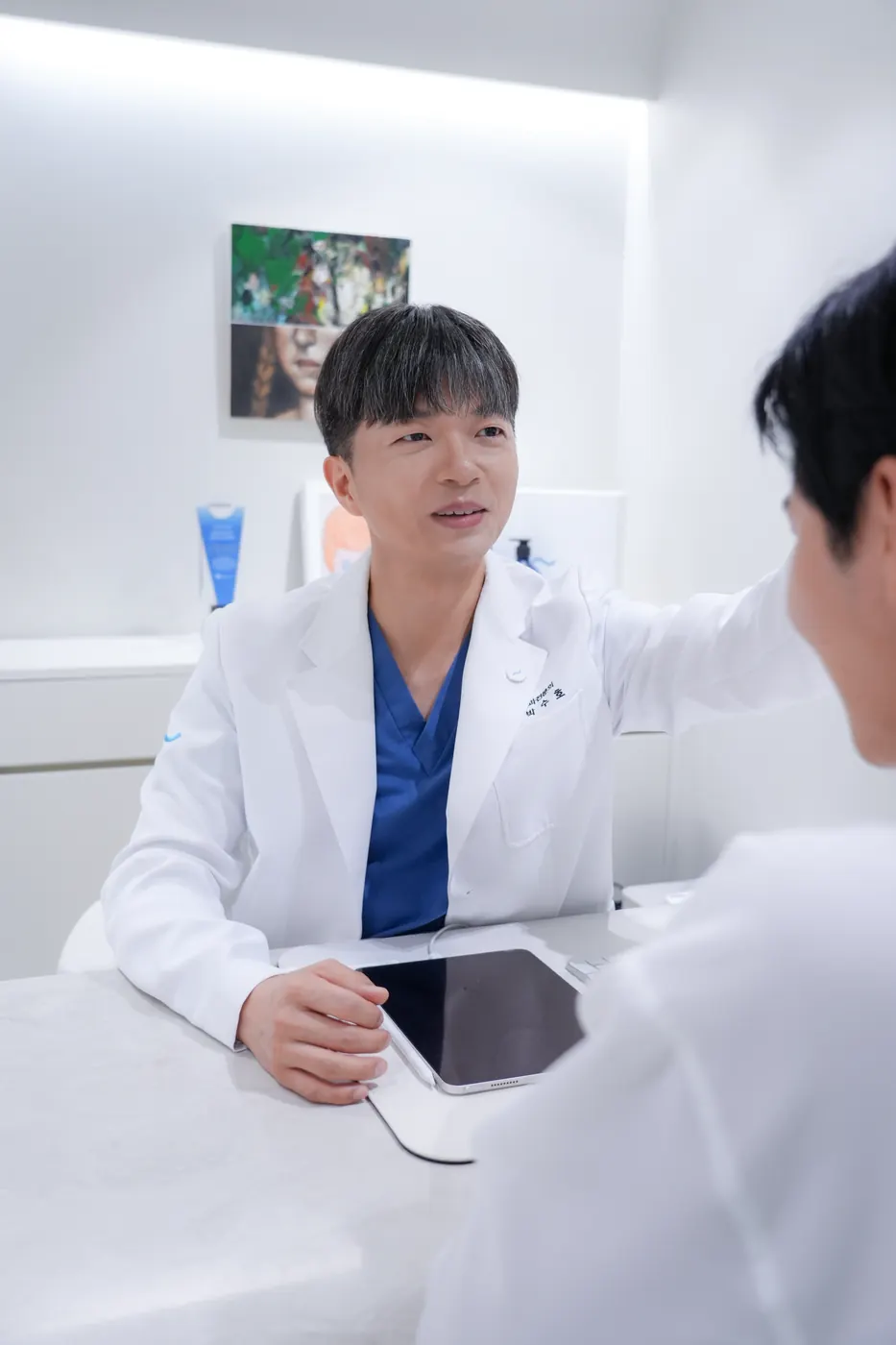
Written by Dr. Park Sooho
After deciding on hair transplantation, many people agonize over incisional versus non-incisional. Both are good methods, and in many cases either choice is fine. However, depending on hair thickness and density, scalp elasticity, and the degree of hair loss, one may give better results in some cases. Below I have roughly summarized, by situation, how strongly I recommend non-incisional. The numbers in parentheses are only to aid understanding and do not exactly match reality.
Situations Where Non-Incisional Is Recommended
If scalp elasticity is insufficient, we recommend non-incisional hair transplantation (100%). Performing an incision when scalp elasticity is inadequate creates significant tension during closure, which can cause severe pain, a wider scar, and skin necrosis. It also makes it difficult to harvest a sufficient amount of hair. That is why we always check elasticity before surgery. Even for people who have already had incisional surgery several times, there is a high likelihood that there is not enough space and elasticity for another incision, so non-incisional is recommended in most cases (90%).
We also guide people who simply feel vaguely afraid of incision (80%), people who do not want a line-shaped scar left behind (70%), and people sensitive to pain (60%) toward non-incisional. Incision scars usually remain as thin solid lines that are hard to see, and even if they widen, most cases are resolved with scar grafting; however, if you dislike line-shaped scars themselves, non-incisional, which leaves many small dots, is better. After incision, a pulling pain like the one felt when hair is tied back lasts several days, whereas non-incisional is relatively less painful. Non-incisional can also sting like water touching a wound the day after surgery, and in rare cases some people experience this for several weeks or feel severe pain.
Situations Where Incision Is Recommended
If cost is a burden (50%), we will explain incision in full. Many people regard non-incisional as the better method because of its name, but the two methods show no major difference in results. Non-incisional costs more because harvesting takes longer. For people who have back or neck discomfort, or who find it difficult to lie face down for long because of claustrophobia, panic disorder, or similar conditions (40%), incision, which has a shorter surgery time, may be more comfortable.
When the amount to harvest is large relative to the head shape (30%), we generally recommend incision for the first surgery as well. People with a wide forehead who need a large hair count often want to narrow it further later, even when the first surgery goes well, because if the entire back of the head has already been densely harvested non-incisionally, it is difficult to harvest again.
For people whose hair is thin and appears sparse (25%), harvesting from the upper back of the head using FUE can reduce the volume at the back when the hair is tied up. In such cases, the FUT method, which harvests hair only from the lower area, may be preferable. People with low density at the back of the head (20%) also face a problem: after non-incision, the spacing between remaining hairs widens to nearly double and the scalp may show through, whereas incision increases the spacing evenly by only a little (about 10%). For the first surgery for female pattern hair loss (10%), we recommend incision that harvests only within a safe zone less influenced by hormones.
For people who have already had non-incisional surgery several times, or whose hair spacing has widened because a large amount was moved by non-incision, we do not recommend non-incisional (0%). Harvesting every other follicle twice widens the remaining spacing fourfold, and since 2- to 3-hair follicles are mainly lost, only 1-hair follicles remain.
You Do Not Need to Give Up One of the Two
Although non-incisional hair transplantation was developed later than the incisional method, that does not mean it is superior. They are methods that complement each other's weaknesses, and choosing and using them appropriately for each situation can produce better results. Insisting on only one means giving up one good option.
When I was in middle school, I once submitted a prototype to a school invention contest that combined a knife and scissors into one. I thought it would be good to use both together, since sometimes scissors are more convenient and sometimes a knife is. The teacher laughed and put it in a drawer, but over a decade later I was pleased to see the same idea come out as a product. The idea that even when the purpose of cutting is the same, tools should be used differently depending on the situation, is the same then and now.
This article is a version, reorganized for this website, of an article our doctor wrote for the “Hair Loss Expert Column” on the hair loss community Daedamo. View original