
By Dr. Kim Narae · 2026.09.08
Hair loss and insulin resistance
People experiencing hair loss often have various systemic metabolic problems in addition to genetic factors and stress. Recently, the medical community has come to view hair loss not merely as a problem of the scalp or hair, but as a strong warning that the body's overall metabolic balance has been disrupted. Among these, the key link that dermatology and endocrinology have focused on most in connecting metabolic syndrome with hair loss is insulin resistance.
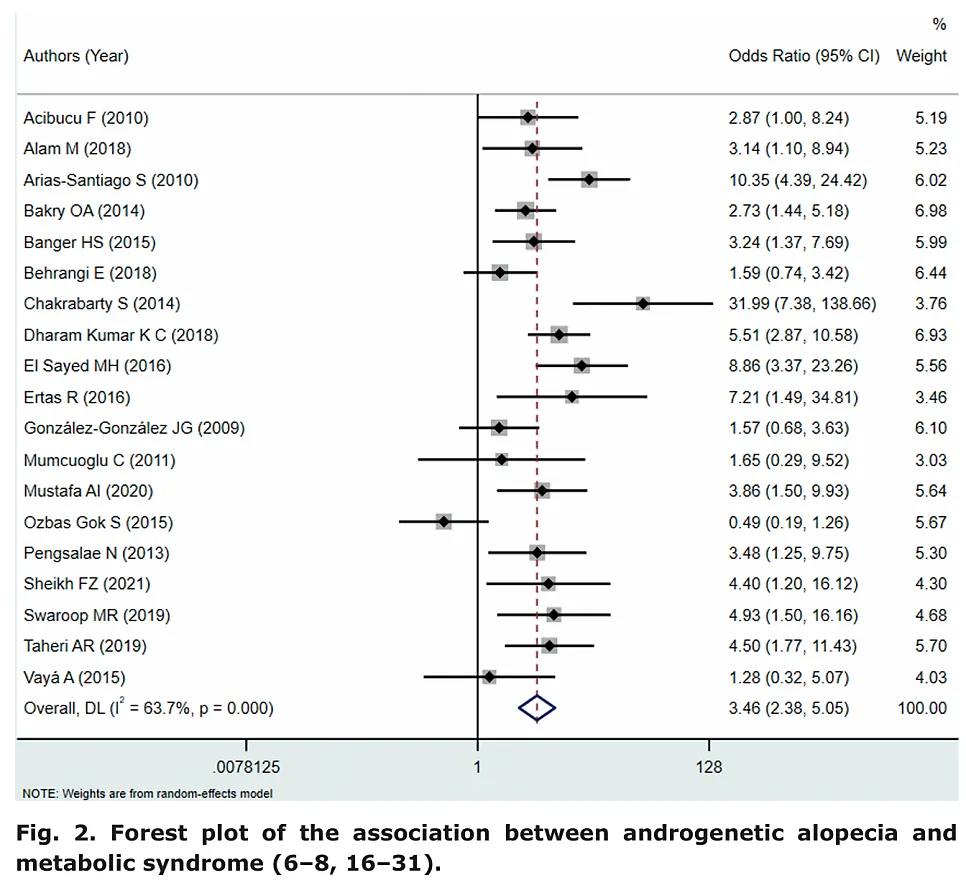
One of the most reliable recent medical findings supporting this is a large-scale meta-analysis (Qiu et al., 2022) published in the international dermatology journal Acta Dermato-Venereologica. Referring to that paper, let us look at the relationship between metabolic disorders and hair loss.
Hair loss patients have 3.46 times the risk of metabolic syndrome
The research team combined and analyzed a total of 19 carefully selected studies (2,531 participants), and found that the risk of metabolic syndrome in patients with androgenetic alopecia (AGA) was 3.46 times higher than in the control group.
High association in female hair loss patients: the risk of metabolic syndrome was much higher in the female patient group, at 7.34 times, than in males (3.08 times). One interpretation is that this may be due to the smaller number of female participants, and another is that it may be due to conditions such as polycystic ovary syndrome, in which hormonal imbalance causes hair loss.
Risk of early hair loss: the "early hair loss" group, which began at a young age before 36, also showed an even clearer correlation with metabolic syndrome.
Overall worsening of metabolic indicators: hair loss patients had significantly higher body mass index (BMI), waist circumference, triglycerides (TG), fasting blood sugar (FBS), and blood pressure (SBP/DBP), while HDL-C, the "good" cholesterol, was low, so their overall metabolic profile was poor.
How are metabolic disorders and hair loss connected?
So how are metabolic disorders and hair loss connected? At the center are insulin resistance and hormonal changes. Insulin is the hormone that moves glucose from the food we eat into cells so that it can be used for energy. However, when excessive sugar intake, lack of exercise, stress, and similar factors persist, cells stop responding properly to insulin, which is called insulin resistance. The body then secretes more insulin to lower blood sugar, which leads to a chronic state of high insulin levels (hyperinsulinemia).
The specific mechanisms by which this affects the hair are as follows.
Decreased sex hormone-binding globulin (SHBG) and androgen activation: When insulin levels rise, the liver's production of SHBG (sex hormone-binding globulin) is suppressed. As a result, the activity of free testosterone and dihydrotestosterone (DHT) in the blood, which are active male hormones (androgens), increases, promoting miniaturization of hair follicles.
Reduced microcirculation in the scalp and oxidative stress: insulin resistance and metabolic disorders weaken the function of the vascular endothelium and increase oxidative stress and chronic inflammation in the body. This impairs blood circulation in the scalp and blocks the supply of oxygen and nutrients that hair follicles need.
Shortened hair growth phase: high insulin levels and metabolic abnormalities shorten the anagen (growth) phase, during which hair grows fully, and cause hair to enter the telogen (resting) phase early, accelerating hair loss.
Lifestyle habits that improve insulin resistance
According to various dermatology and endocrine metabolism studies, people with metabolic syndrome or high insulin levels clearly tend to have lower hair density and thinner hair in the frontal and crown areas. Therefore, to fundamentally improve hair loss, it is essential to combine it with lifestyle habits that improve the body's insulin resistance and correct metabolic indicators, rather than relying only on medications applied to or taken by mouth, or on hair procedures.
Let us look at which lifestyle habits can help.
Correcting eating habits that stimulate blood sugar: refined carbohydrates (white flour, sugar) and liquid fructose cause excessive insulin secretion and are the main culprits that damage metabolic indicators. Try switching to a diet centered on whole grains, fresh vegetables, and healthy protein.
Maintaining muscle mass and aerobic exercise: muscle is where the most glucose is consumed. Along with light walks after meals, consistently doing strength training focused on the lower body greatly helps improve insulin sensitivity.
Adequate sleep and stress management: cortisol, the stress hormone, also increases insulin resistance. Sufficient rest and stress control are the foundation of hair health.
Regular checkups of metabolic indicators: regularly check blood pressure, fasting blood sugar, cholesterol levels, waist circumference, and so on, so that the risk of cardiovascular disease can be prevented early, alongside hair loss treatment.
Hair is the mirror that first reflects the body's metabolic state. Even though it is not visible from the outside, restoring a healthy balance to the body's metabolic system is the most fundamental and reliable way to protect healthy hair.
Why is hair loss more common in the US?
So why is hair loss more common in the US? Hair loss is strongly influenced by genetics, but dietary habits cannot be ignored. In particular, because of a diet centered on refined carbohydrates and highly processed foods, the US shows an unusually high prevalence of metabolic disease. Such metabolic abnormalities act as an important trigger that causes or worsens latent hair loss.
I think this shows once again that anti-androgen treatment, the foundation of hair loss treatment, must be accompanied by normalizing the body's metabolic system through improved diet and lifestyle habits.
Source: Qiu Y, Zhou X, Fu S, Luo S, Li Y. Systematic Review and Meta-analysis of the Association Between Metabolic Syndrome and Androgenetic Alopecia. Acta Dermato-Venereologica. 2022;102:adv00790. doi:10.2340/actadv.v102.4071.


