By Dr. Kim Narae · 2026.11.12
Back-of-the-Head Hair That Does Not Fall Out When Transplanted
All the hair at the front and crown falls out, so why does the hair at the back remain to the end? And is it really true that hair from the back does not fall out even when moved to the front?
That is right. Follicles at the back of the head have few receptors that respond to DHT, the male hormone that causes hair loss, and their enzyme activity is also low, so they escape the attack of genetic hair loss. Thanks to this characteristic, known as "donor dominance," hair transplant surgery is possible.
But why was only the back of the head made to be safe from hair loss?
A Hypothesis Reaching Back 4 Million Years
Not long ago, I read an interesting article by Dr. Bruno Jacobovski of Spain in the September/October 2026 issue of Hair Transplant Forum International. It is a story from 4 million years ago, hidden in our hair.


To be clear up front, this story is a hypothesis that still needs to be verified.
The Back of the Head: Where the Sun Hit Our Ancestors When They Walked on All Fours
The evolutionary history of primates spans about 60 million years. Of that, humans began to stand upright and walk on two legs only about 4 million years ago. For a very long time before upright walking, our ancestors moved on all fours, like chimpanzees, with their bodies bent forward.
If you imagine them crawling on all fours to run or hunt, the part that would take the direct sunlight from above most head-on would not be the crown or the forehead as it is today. It would have been the back of the head, the highest point when the neck is stretched forward.
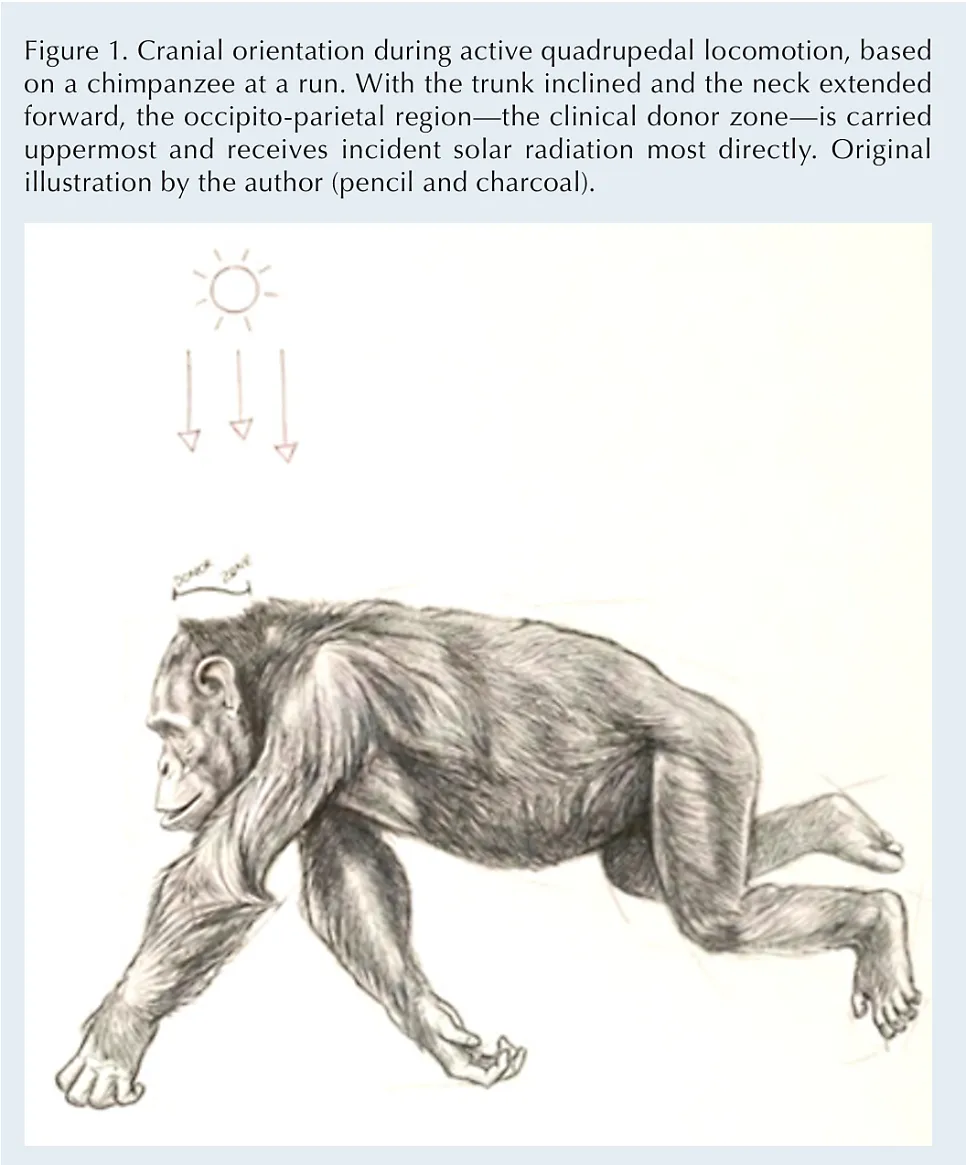
The back of the head shields the brain from the sun's heat. For that reason, this hypothesis explains that genetic variations causing hair loss in this area were disadvantageous for survival and were naturally filtered out. The front hairline and crown were different. When our ancestors walked on all fours, they were relatively less exposed to sunlight, so variations causing hair to thin or fall out did not significantly hinder survival and remained in place.
Positions Reversed as We Stood on Two Legs
When we began to walk upright, the areas that receive the most direct vertical sunlight became not the back of the head but the front hairline and the crown. However, evolution could not keep up with that change as quickly. The front hairline and crown, which should shield the scalp from sunlight, became genetically vulnerable, so hair loss progresses there, and an irony arose: only the back of the head, which gets less sunlight, remains full.
Not strengthened, but simply remaining
It is usually described as the follicles at the back of the head having become "resistant" to hair-loss hormones, which makes it sound as if only the back of the head has newly gained a special defense. Dr. Jacobovski suggests looking at it from a slightly different angle. Originally, all the hair on our body was designed not to fall out, and only the back of the head best preserves that original trait. In other words, the back of the head has not become especially strong; rather, the front hairline and crown have changed in a way that causes them to lose hair.
As a doctor who carefully harvests the follicles from the backs of patients' heads in the operating room every day, I would like to introduce this paper, because it gave me a chance to think more deeply about back-of-head follicles that I had taken for granted.