By Dr. Kim Narae · 2026.08.18
Anti-androgen drugs used together with minoxidil
The most commonly prescribed basic medication for female hair loss is minoxidil. However, minoxidil cannot directly block the mechanism of the androgen hormone that causes hair loss. So depending on the case, anti-androgen drugs that suppress the hormone's action are sometimes used together with it.
Anti-androgen drugs used for female hair loss treatment are mainly used off-label, but when they are taken appropriately for the right case, they can be very helpful for hair improvement.
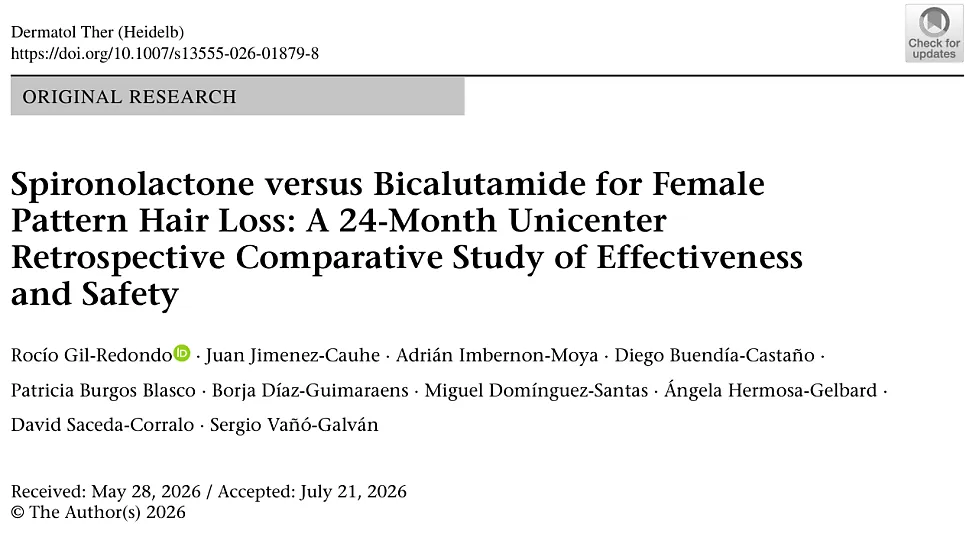
In this regard, a 24-month clinical study has been published that directly compared the long-term treatment effects and safety of spironolactone and bicalutamide, two representative anti-androgen treatments recently prescribed to women with female pattern hair loss. I would like to introduce it here.
187 women with hair loss, followed for 24 months
This study was conducted on 187 women with hair loss who were prescribed spironolactone or bicalutamide at a hair loss center in Spain from 2018 to 2022 and completed follow-up for 24 months or more. Of these, 128 were in the spironolactone group and 59 were in the bicalutamide group. The treatment effect was measured by changes in the Sinclair grade, which is widely used as an indicator of severity in female pattern hair loss.
Notably, 94% of all study participants were also taking oral minoxidil. This can be seen as a good reflection of real clinical practice, in which patients already use minoxidil as their basic treatment, or add an anti-androgen treatment to boost hair improvement that minoxidil alone could not achieve.
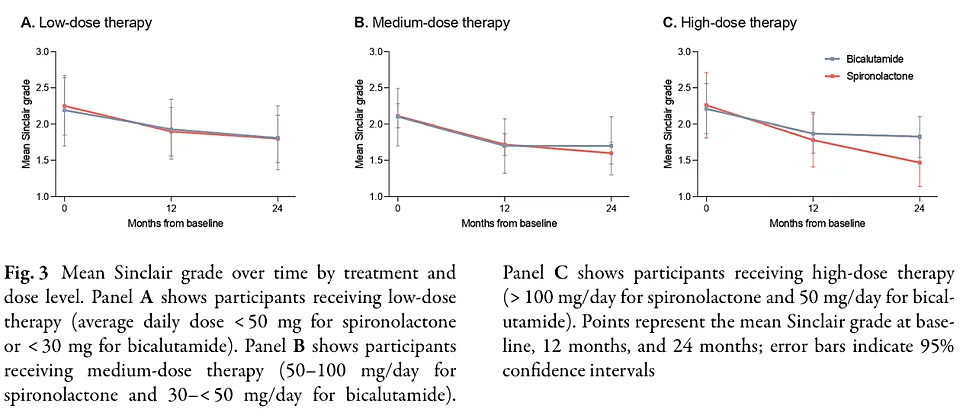
Proportion showing improvement of one level or more, and differences by dose
The results showed that both drugs, when taken steadily for two years, improved the Sinclair grade by an average of 0.5 levels, showing that they are effective in relieving female hair loss symptoms. However, the proportion achieving an improvement of one Sinclair level or more, which means a clearly visible improvement in hair condition, differed between the two drugs. In the spironolactone group, 54.4% of patients showed a clear improvement of one level or more, whereas only 37.3% of the bicalutamide group showed an improvement of one level or more.
The dose-based analysis also showed a difference between the two drugs. Compared with the highest bicalutamide dose of 50 mg per day, the high-dose spironolactone group taking more than 100 mg per day showed clearly superior hair improvement.
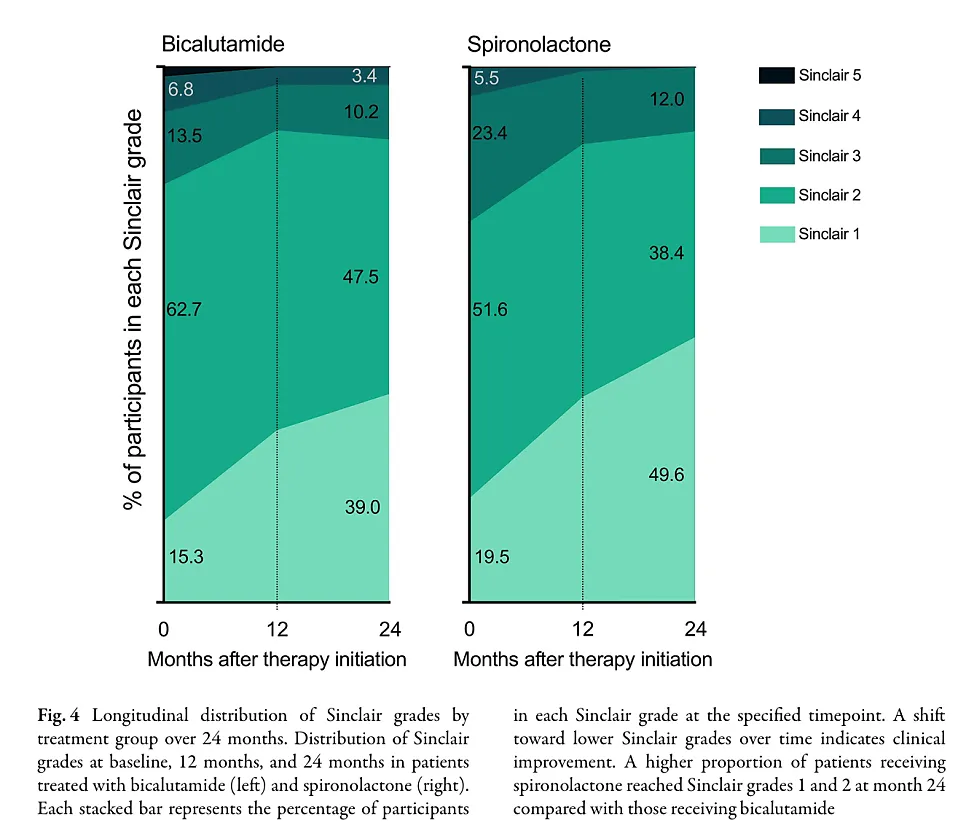
Based on the results of this 24-month comparative clinical study, spironolactone at a high dose of more than 100 mg per day can be expected to produce better hair improvement than bicalutamide. In addition, it was reported that spironolactone is associated with fewer abnormal test findings, such as elevated liver enzymes, compared with bicalutamide, so the burden of regular blood tests or hospital visits is relatively lower.
References: Gil-Redondo R, Burgos Blasco P, Saceda-Corralo D, Jimenez-Cauhe J, Imbernon-Moya A, Buendía-Castaño D, et al. Spironolactone versus Bicalutamide for Female Pattern Hair Loss: A 24-Month Unicenter Retrospective Comparative Study of Effectiveness and Safety. Dermatol Ther (Heidelb). 2026.