
By Dr. Kim Narae · 2026.07.21
Can Thick Hair Still Transplant Naturally?

Today I would like to talk about one of the questions I often hear in the treatment room.
My hair is thick. Can it transplant naturally? Is non-incisional better, or incisional?
Recently, more people seek a hair transplant not only to adjust the forehead height (vertical proportion) but also to narrow the side margins (horizontal proportion) and soften a broad, round face into a more slender shape. I also think there is no method as simple and reliable for balancing facial proportions as a hair transplant.
However, to achieve a satisfying result, naturalness above all is essential. The transplanted hair must blend with the existing hair in texture and density without a sense of incongruity, and the starting edge of the hairline in particular should look fine and light.
If the patient's back-of-head hair is relatively thick, the operating surgeon's effort and know-how are needed to make the hairline look natural. I will explain how even cases with thicker hair can be transplanted naturally, depending on the harvesting method and transplant technique.
Differences by Harvesting Method
The hair at the back of our head varies in thickness depending on the area. The hair at the nape and behind the ears is the thinnest, and it gradually gets thicker toward the center of the back of the head. To be more precise, it gets thicker up to a certain zone, after which it mostly becomes similar in thickness to the thickest hair at the center of the back of the head, and this zone varies greatly from person to person.
Also, the characteristics of the hair needed differ depending on the area to be transplanted (hairline, sides, crown, etc.). Hairline baby hairs are light or brownish, while back-of-head hair can be a glossy, deep black. In some cases, even hair harvested from the nape or behind the ears feels thick when transplanted to the sides of the face. Therefore, the most important thing is to find thin hair that can blend well with the transplant area and harvest the needed amount appropriately.
If there is enough thin hair behind the ears and the patient is not reluctant about the incisional method, the incisional method can also be a good surgery. But what about when there is almost no thin hair behind the ears, yet thin hair is spread widely above the nape? In such cases, the non-incisional method, which selectively picks only thin hair to plant at the hairline, sides and sideburns, is much more advantageous. It is also suitable for people who are sensitive to pain or want to avoid linear scars.
Differences by Transplant Method
The result varies greatly depending on how, and in what order, the hair is planted. Even hair of the same thickness does not look very awkward when planted at the center of the hairline, but when moved to the sideburns, it can feel quite thick and coarse.
Also, simply planting only thin hair in many dense rows does not automatically make it look natural. The ideal method is to plant thin hair in the first row of the hairline and place slightly thicker hair progressively further back, varying the density. And rather than planting the whole line from the center of the hairline to the sideburns uniformly, creating a precise gradient by varying it area by area allows the hairline to begin gradually and naturally.
Case of a Patient with Thick Hair
To help understand, I will describe one of the most common scenarios when a patient with relatively thick hair visits.
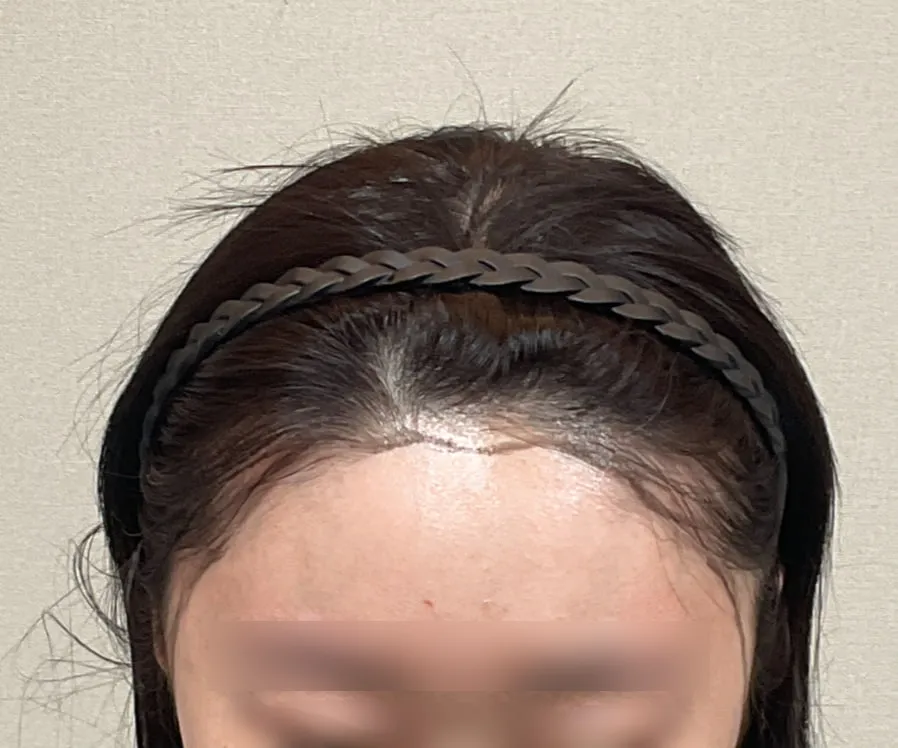
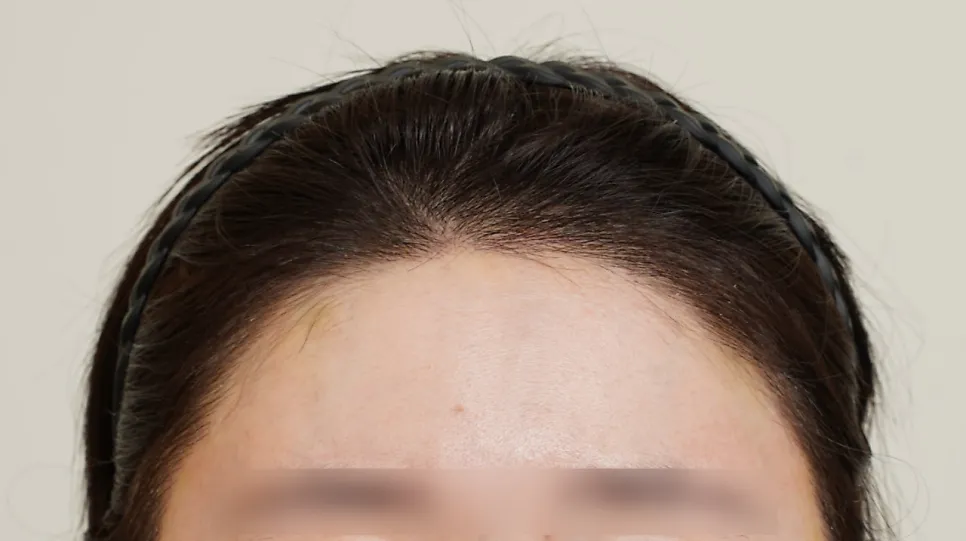
Overall, the hair has a certain thickness, but the patient wants to narrow the side margins enough to be noticeable even from the front and to newly connect the sideburns. At the same time, they want to round the angular hairline to achieve a feminine, slender face shape. However, their hair is not very thin, so they are very worried it may look unnatural.
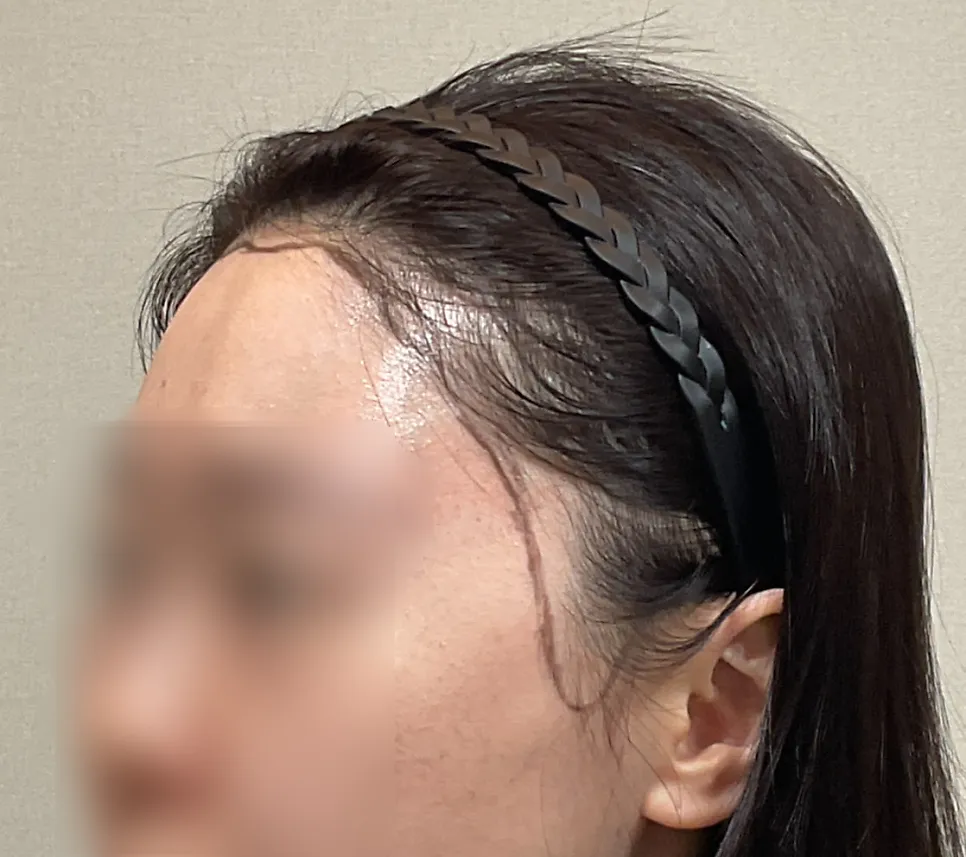
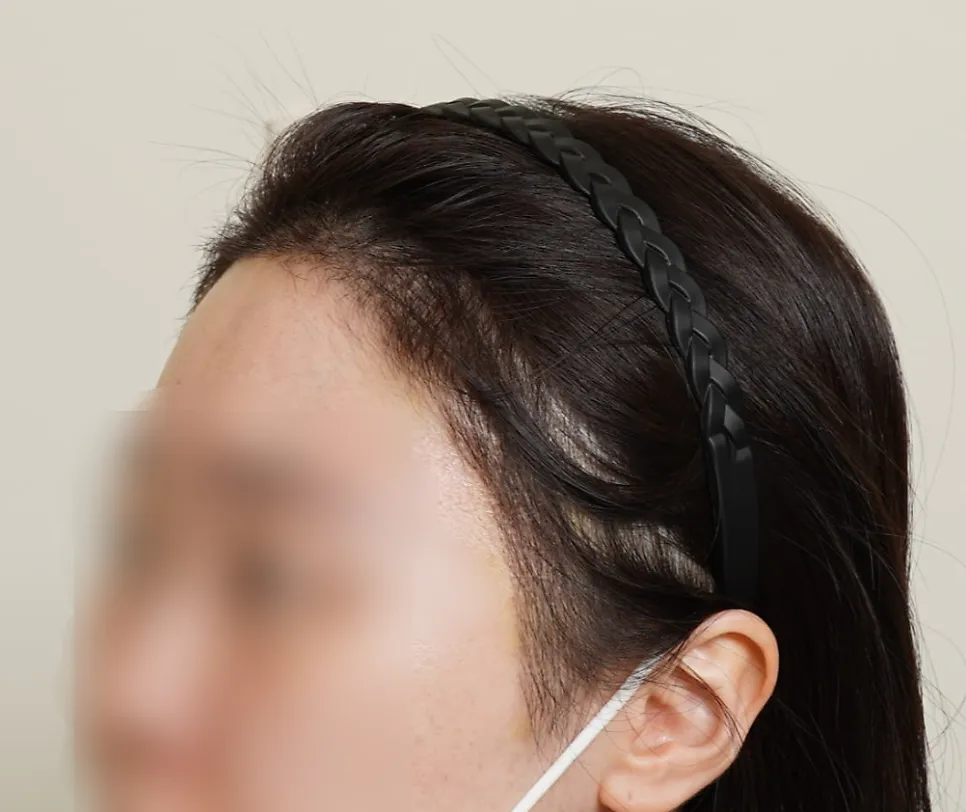
In this kind of case, a considerable amount of thin hair is actually needed. This is because the design, which starts from the center of the hairline, creates a temporal peak on the sides and continues to the sideburns, must be filled beginning with thin hair. When people with thick hair correct such a wide area, the amount of thin hair obtainable from behind both ears using the incisional method can be far from sufficient. For that reason, you must estimate the amount of thin hair obtainable from the back of the head and reflect it in the design.
The scalp of the temporal area has relatively low elasticity and blood circulation, and it is also an area where the harvest width cannot be widened much, so it is difficult to harvest more using only the incisional method in the temporal area. Some thin hair is mixed in at the center of the back of the head as well, but on average there is much more thick hair, so in such cases the surgery is performed with the non-incisional method.
Starting just above the nape, we harvest hair with the lightest color and thinnest diameter as much as possible. If the temporal hair is harvested too densely, the scalp may show through when the hair is pulled back tightly, but with the same amount of harvesting from above the nape, the likelihood of the scalp showing through is low.
I believe that naturalness is everything in hairline surgery, and this naturalness is closely related to the thickness of the back-of-head hair. If you hesitated because you thought thick hair might not transplant naturally, I want to let you know that it can be overcome with the delicate design and know-how of our medical team.
※ Side effects such as pain, swelling, inflammation, bleeding and infection may occur after a hair transplant. ※ All photos on this blog are used with the patient's consent.


