
By Dr. Kim Narae · 2026.02.14
Thinning Hair and Hair Loss Medication
Not only aging, but also frequent perms and hair coloring can gradually weaken our hair and make it thinner. In particular, as hair loss progresses, the growth phase in which hair grows healthy becomes shorter, and the phenomenon of hair becoming thin and weak, called miniaturization, becomes more noticeable.
For hair to become thick again as hair loss eases, the basics are to get enough nutrients such as protein, iron, vitamin B complex, and zinc, and to improve your lifestyle habits. However, to slow the progression of hair loss more quickly and reliably, medical help, that is, hair loss medication, is often needed.
Topical Minoxidil and Oral Minoxidil
Minoxidil is the most proven way to thicken hair and the ingredient that forms the basis of female-pattern hair loss treatment. You may be most familiar with it as a topical applied directly to the scalp, but in the last five years, low-dose oral minoxidil has become very popular, so many people may know it as a pill.
So we would like to introduce the effectiveness and safety of low-dose oral minoxidil in detail, through a review article published in JAAD, a dermatology journal with worldwide authority.
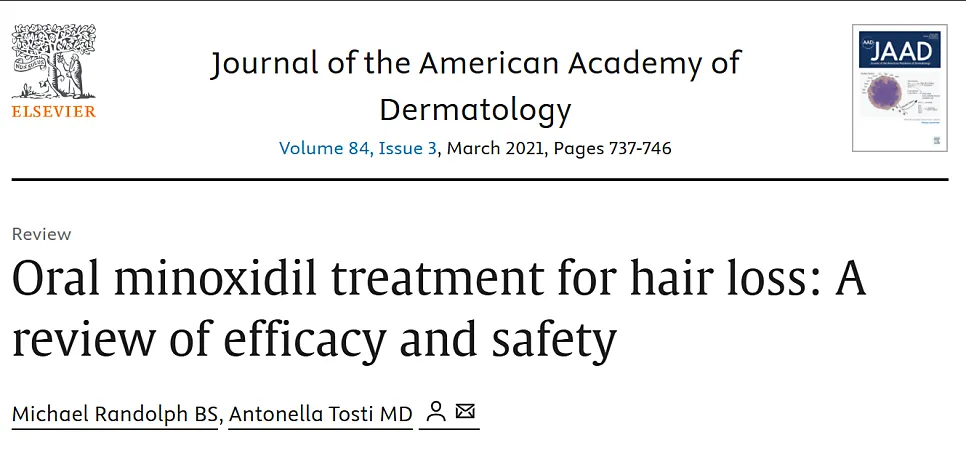
This paper contains in-depth content on the efficacy and safety of oral minoxidil. Topical minoxidil is also quite effective, but it has to be applied every day without fail, and because of the hassle and scalp irritation, patient adherence tends to be somewhat low. Moreover, for minoxidil to work, it must be converted by an enzyme in the body called sulfotransferase into its active form, minoxidil sulfate, and unfortunately some people do not have enough of this enzyme in their scalp, so even with diligent application they may not see the results they expect.
When taken orally, the story is different. Because it passes through the liver, which contains many enzymes that activate minoxidil, it produces much more stable and powerful effects. Of course, the need to take a pill every day may feel like a psychological burden to some people.
The Effects of Oral Minoxidil Seen in 16 Studies
Through this paper, which carefully reviewed a total of 16 studies and describes how effective oral minoxidil is for various hair loss conditions and how safe the drug is at the same time, let's take a closer look.
In the treatment analysis of 622 patients in total, it was studied most in androgenetic alopecia and was effective in both men and women. In women, low doses of 0.25–1.25 mg were effective, and in particular, when combined with spironolactone, it could lower the risk of edema while also increasing effectiveness. In men, doses of about 2.5–5 mg were found to be more effective.
Side Effects of Low Doses of 5 mg or Less
Next, let's talk about side effects, which people are most curious about. Unlike high doses (10–40 mg) that were used as blood pressure medication, at low doses of 5 mg or less, side effects were generally mild.
1. Hypertrichosis (excessive hair growth): the most common side effect (about 20%), occurring more frequently especially in the 5 mg group, but most patients considered it manageable and did not stop treatment.
2. Temporary shedding: Hair may temporarily fall out more during the first 3–6 weeks of treatment, but this is a natural phenomenon.
3. Cardiovascular side effects: Rarely, swelling in the lower body (about 3%), orthostatic hypotension and dizziness (about 2%), and minor ECG changes (about 1%) have been reported, but there were no serious cases.
Since it is a drug used off-label
In conclusion, oral minoxidil can be a very effective and excellent treatment option for healthy hair loss patients who have found it inconvenient to use topical products. However, because it is currently used off-label (prescribed outside its approved indication) for hair loss treatment, it is important to consult an expert without fail and take it while carefully checking your condition through regular medical visits.


