
By Dr. Kim Narae · 2025.12.30
Concerns and Questions About Dutasteride

"Dutasteride" is a hair loss medication that many people who are considering hair loss treatment may have heard of. Because it is generally more potent than finasteride, many people worry that its side effects may be correspondingly greater. In fact, when hair loss is progressing quickly, or when symptoms persist even while taking finasteride and stronger DHT suppression is needed, dutasteride is prescribed. Each time, I can sense deep concern about side effects in patients' eyes, and I often receive a variety of questions.
Is it okay to take one tablet every other day? Is it okay to split it? Is it okay to alternate with finasteride and take it every other day?
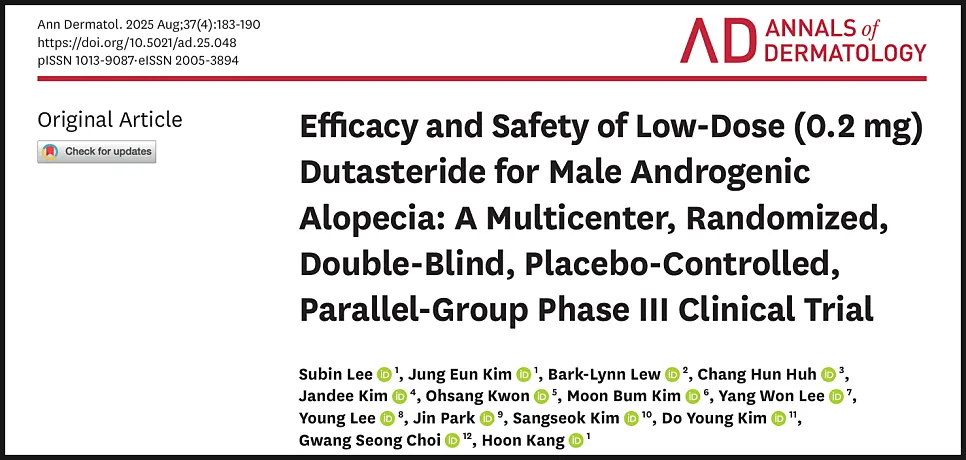
A Study on Korean Patients Published in Annals of Dermatology in 2025
There is welcome, up-to-date research news that may ease these concerns, so I would like to introduce it. This is a study on Korean patients published in Annals of Dermatology in 2025, and it presents interesting findings on how effective and safe low-dose dutasteride at 0.2 mg is.
Most dutasteride currently prescribed on the market is in the 0.5 mg formulation. However, this research team started from the clinical question, "Could the dose be reduced by half or more while maintaining the effect and still lessening the burden on the body?" and confirmed the potential of 0.2 mg. The study involved 139 Korean male patients aged 18 to 50, divided into a placebo (dummy pill), a 0.2 mg group, and a 0.5 mg group, and was conducted over 24 weeks using a double-blind method.
Increase in Hair Count in the 0.2 mg Group
Fig.2: Hair counts in the dutasteride 0.2 mg and 0.5 mg groups increased statistically significantly compared with the placebo group. The 0.2 mg group showed a larger difference, but there was no statistically significant difference between the two treatment groups.
Here are the results. The 0.2 mg group showed an increase in hair count about 3.6 times higher than the placebo group. What was remarkable is that compared with the existing 0.5 mg group, there was no statistically significant difference in effect. In other words, it has been shown that even with a reduced dose, hair loss treatment effects can reasonably be expected.
Side Effects and Hormone Levels
The results were also positive regarding side effects, which many people are most concerned about. Sexual function-related adverse reactions such as decreased libido or ejaculation disorders were almost absent in the 0.2 mg group or were recorded at a low level with no major difference from the placebo group. Compared with the 0.5 mg group, these figures are very reliable in terms of safety, and if psychological factors are also considered, 0.2 mg can be a very good option for continuing treatment while minimizing physical burden.
Furthermore, 0.2 mg showed the characteristic of effectively suppressing DHT, the main cause of hair loss, while adjusting hormone levels more gently than 0.5 mg. In other words, the study reached a meaningful conclusion that the clinical effect of slowing hair loss is comparable to 0.5 mg, while the impact on hormones in the body is much smaller.
Long-Term Research Findings Are Needed
In conclusion, this study suggests that low-dose dutasteride therapy at 0.2 mg, or a cycle-adjusted therapy using it, may be a good option for people who have hesitated over treatment out of fear of side effects. However, because this study was conducted over a short period of 6 months, to strengthen confidence in the findings, long-term research on the side effects and effectiveness of low-dose dutasteride regimens, such as taking 0.2 mg or taking it every other day, will need to be supported going forward.


