
By Dr. Park Sooho · 2025.11.09
Incision scars need attention at every stage
One concern when choosing incision hair transplant is the incision scar. However, contrary to concern, incision hair transplant scars are rarely noticeable, and even hair salons often cannot find them. To achieve this, attention is needed at every stage.
At the consultation, the scalp condition must be measured accurately. We must judge whether the scalp is soft enough and dense enough to harvest sufficient hair count for the transplant. Then we decide whether incision, non-incision, or both methods should be used together. If an incision is needed, the incision width is also estimated in advance.
When designing before surgery, because elasticity varies by location on the scalp, the incision width must be designed carefully and differently for each area. This process must be done directly by the operating surgeon. If someone else designs it on your behalf, it becomes difficult to respond to the elasticity that varies by area when the incision is actually made.
During incision, we continuously check the follicle angle to make sure the surrounding follicles are not damaged. Even if the incision line was carefully determined before surgery, during the actual incision we frequently check elasticity and adjust the incision width.
Trichophytic suture
Although the name of this suturing method is somewhat difficult, it lets hair grow along the scar line and covers the scar. I will explain with illustrations.
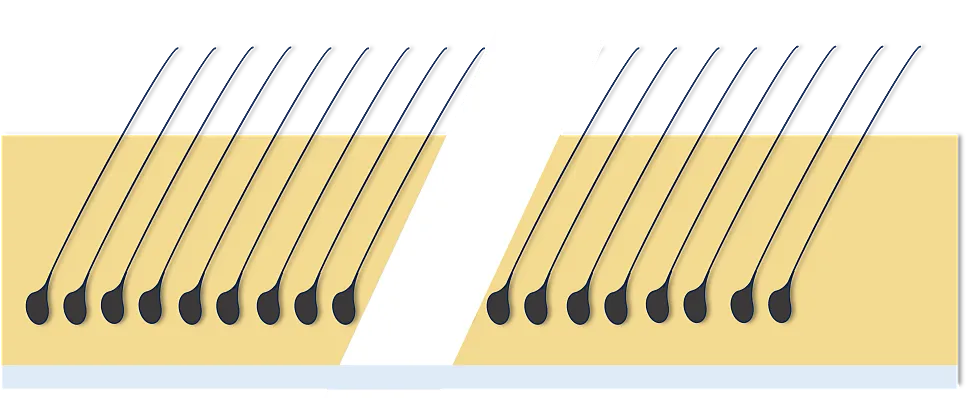
The incision is made according to the elasticity of the scalp, without damaging the surrounding follicles.
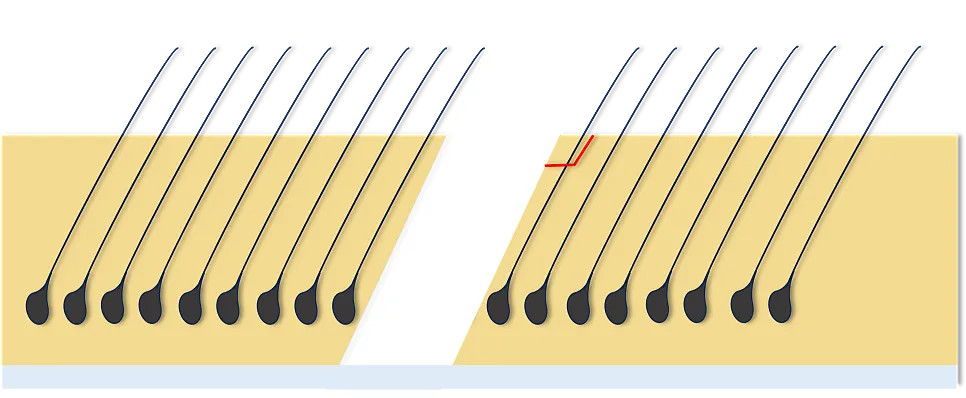
Next, only the skin layer on one side is gently removed.
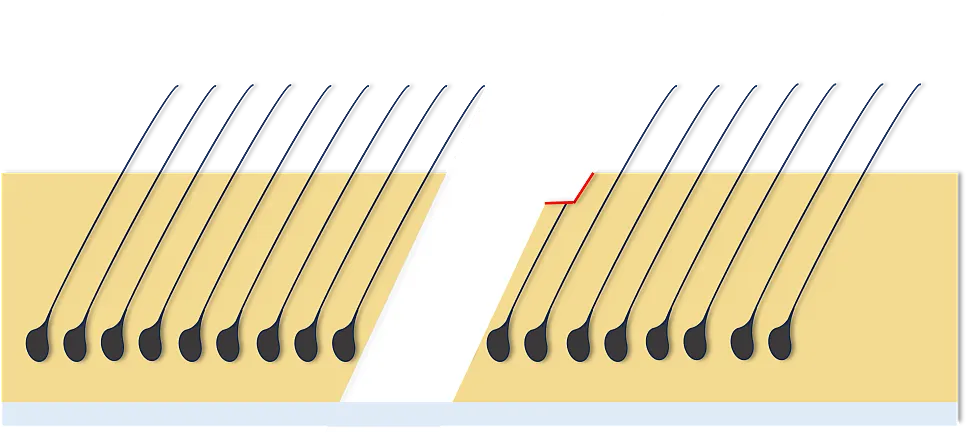
The skin layer has been removed, but the follicles beneath it remain.
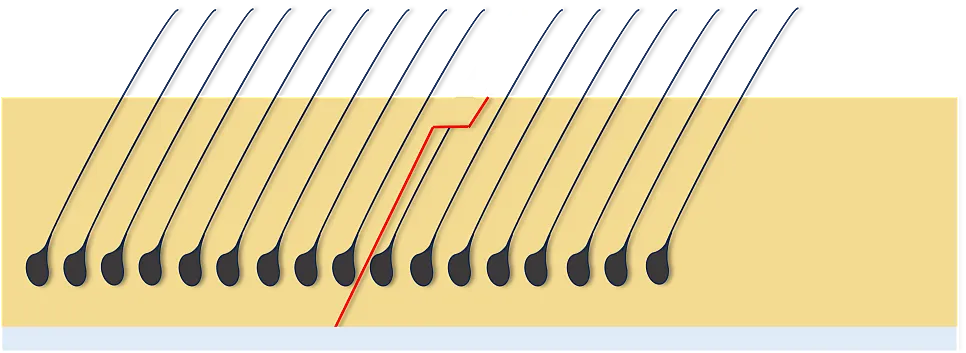
The area where only the skin was removed is covered with skin from the opposite side and sutured.
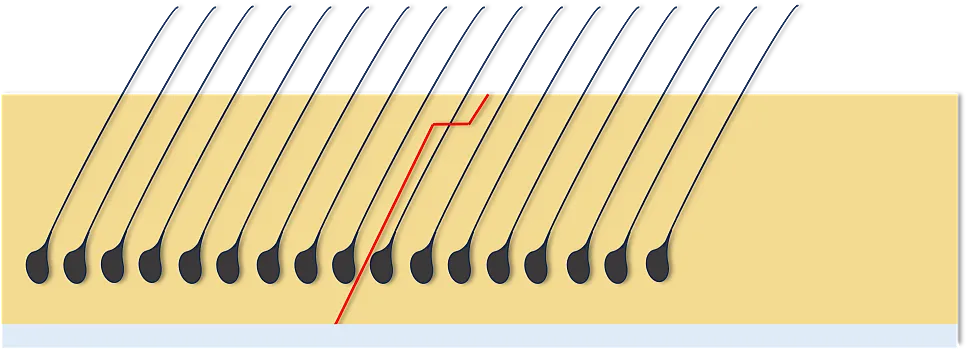
Then the follicles that remained beneath the skin grow up through the skin, covering the scar. That is the principle.
Galea plication
The most important factor in how much an incision scar remains is the tension pulling from both sides, which widens the scar. A sutured wound heals within about one week, but the tension on the wound takes much longer to disappear. So once the sutures are removed, there is no longer any force bearing the tension, and the scar line can widen. For this reason, a way to hold tension for a long time beneath the skin layer is needed, and galea plication is one such method.
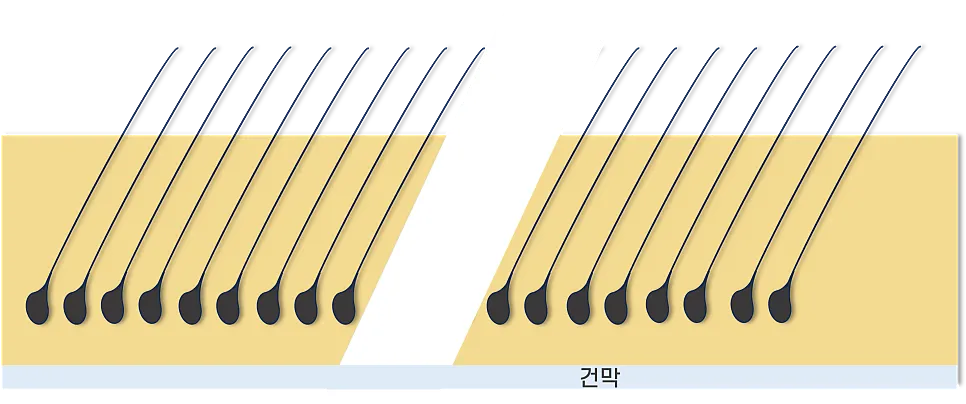
In the incision method, the tissue harvested extends down to the fat layer just above the galea among the layers of the scalp.
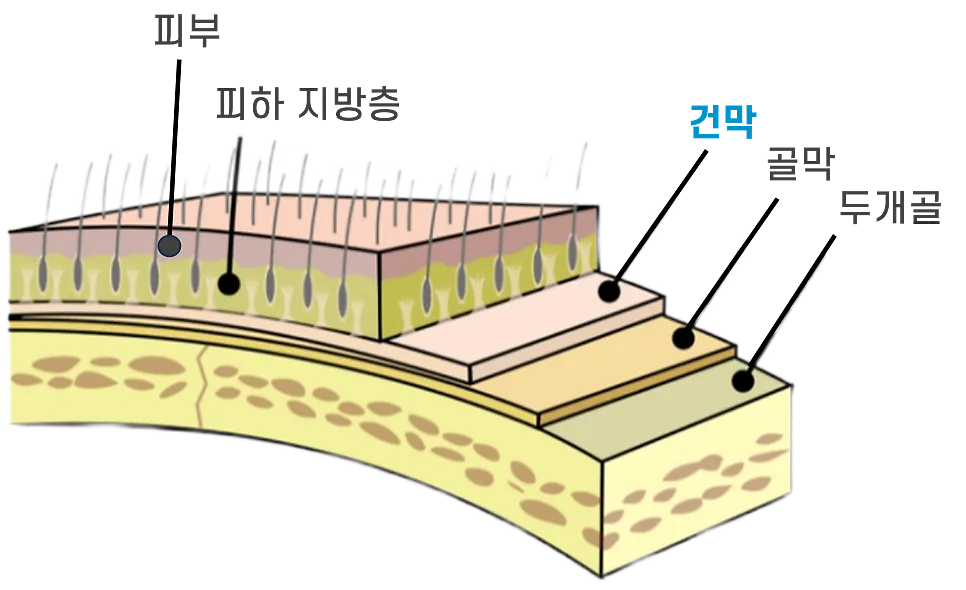
Once the incised strip is removed, the galea is visible underneath. Because this galea is a fairly firm tissue, it does not easily tear even when a suture is pulled through it.
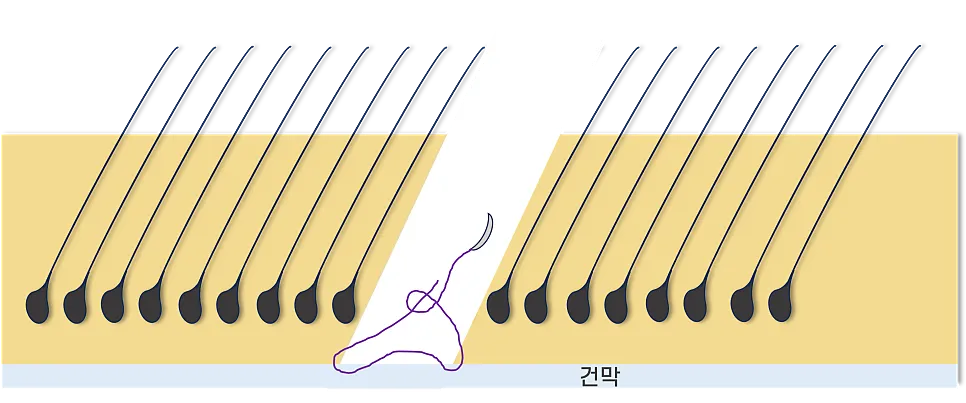
So instead of suturing the skin under tension right away, we pass sutures through the galea at both ends of the incision and pull them.
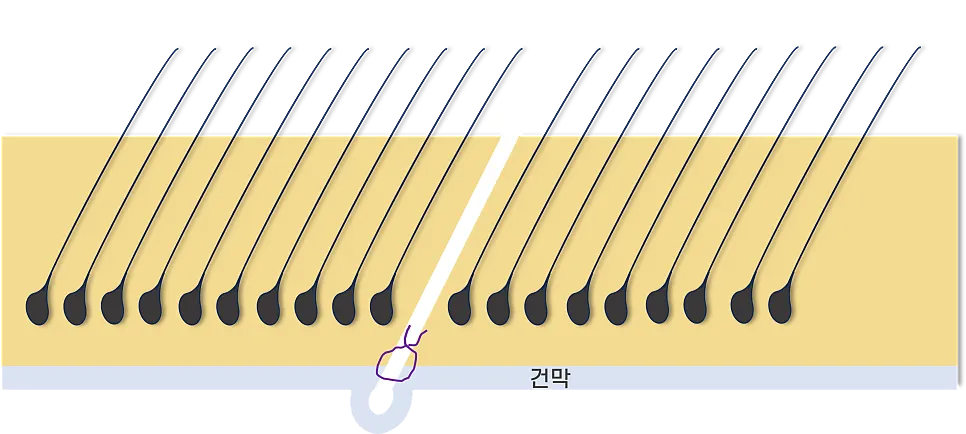
This causes the galea to fold and the incision width to decrease. Doing this suture several times along the incision greatly reduces the tension across the whole incision. Then, even after the sutures closing the skin are removed, the force bearing tension beneath the skin is maintained, which prevents the scar from widening.
Skin suturing and postoperative care
Because galea plication brings the wound surfaces together almost touching, skin suturing only needs to align the edges of the wound smoothly.
Wounds must always be kept moist in order to heal well. After surgery, just apply ointment well so the wound does not dry out.
If you are concerned about scars
Depending on the degree of hair loss or scalp condition, the incision method may be a better choice for some people. Yet there are times when people hesitate out of concern about incision scars; with careful suturing as described above, scars large enough to bother you in daily life are rarely left (even hair salons often cannot find them). If a scar does become slightly visible, it can also be covered by lightly implanting grafts into the scar using the non-incision method.
If you need an incision but are worried about the scar, there is no need to worry too much.


