By Dr. Kim Narae · 2025.10.07
Can Hair Loss Be Managed with Black Beans?
This is a question many people struggling with hair loss have probably wondered about at some point. Can hair loss really be managed with black beans? Black beans are often mentioned as a good food for hair loss because they are full of nutrients that are good for hair. But let us look at whether there is really scientific evidence behind this claim.

Black beans are rich in proteins, minerals, and antioxidants that are essential for hair growth. In particular, isoflavones, a plant-based estrogen, can help slow the aging of follicle cells and help keep hair healthy.
Of course, black beans alone cannot completely cure hair loss. However, what matters is consistently supplying the nutrients hair needs through a balanced diet that includes black beans, and this can clearly help ease hair loss symptoms as a supportive effect.
Review Paper on the Role of Food Nutrients
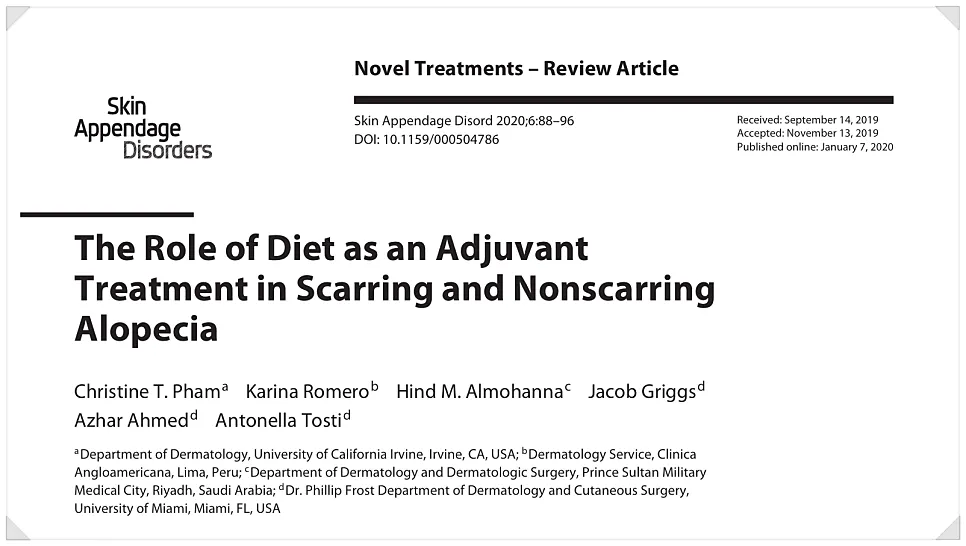
Through a review paper published by Professor Antonella Tosti, an authority in hair science, and several research teams, we will look at the role of food nutrients, including soy isoflavones, in hair loss treatment.
This review was conducted through a systematic literature review and meta-analysis, and it included all types of studies that evaluated the effects of food on hair loss, including scarring hair loss caused by inflammation. After excluding animal experiments, basic science research, and supplement-related studies, the reliability of clinical data was assessed for 3,261 papers, and 24 papers were finally selected for analysis.
Let me summarize in detail, by condition, the papers on how a healthy diet affects hair loss.
Androgenetic Alopecia
First, for androgenetic alopecia, the results showed that foods rich in isoflavones, a Mediterranean diet, and adequate protein intake help promote hair health and growth and help prevent hair loss.
A particularly interesting result: in a study of 354 Taiwanese men that compared a group that often drank soy milk (three or more times a week) with a group that did not, the group drinking soy milk three or more times a week had a 77% lower rate of hair loss, and the study found it may also help prevent progression to moderate or greater hair loss. It can be interpreted that isoflavone-rich foods such as soy have antioxidant and estrogen-like activity, which helps hair.
Alopecia Areata
For alopecia areata, a gluten-free diet and protein intake are said to play a major role in preventing the condition. In particular, in patients with alopecia areata who also have celiac disease, a diet without gluten (wheat, barley, oats) was shown to promote hair growth. This appears to be because stopping gluten intake, which causes intestinal inflammation, reduced inflammation and improved the gut microbiome environment.
And, as with androgenetic alopecia, insufficient protein intake can worsen alopecia areata, so adequate protein intake is important.
Telogen Effluvium
Finally, telogen effluvium. Telogen effluvium caused by severe stress, nutritional imbalance, illness, surgery, or other physical stress also requires adequate protein intake for hair recovery. One study found that 75% of 8 patients being treated for telogen effluvium had a protein intake of less than 30 g per day, suggesting that, more than expected, many people do not eat a balanced diet.
The Supportive Role of a Healthy Diet
In conclusion, a healthy diet can play an important supportive role in hair loss treatment. Keeping in mind that supplying appropriate nutrients is the foundation for hair growth and maintenance, you can prevent hair loss at least to some extent, and if hair loss has already started and you are receiving treatment, the effect can be maximized.
Considering that soil quality has declined and that faster harvesting for breeding and distribution has lowered the nutritional content of food, it would be even better to supplement with nutrients whose deficiency can worsen hair loss.
If you have been wondering whether black beans can help with hair loss treatment, it means you care about hair health. I hope this interest in basic nutrition for hair growth will lead to the prevention and relief of hair loss.