
By Dr. Kim Narae · 2025.09.23
If You Are Worried About Stress-Related Hair Loss
Are you concerned because you have been losing a lot of hair lately? If you are worried that it may be stress-related hair loss caused by a busy daily life and repeated stress, please read this article to the end. We will look at how stress affects hair loss, as well as interesting research findings on how nutritional supplementation can help improve it.

Allostatic Load and Its Strain on the Body
Stress is often thought of as a mental issue, but in fact our bodies respond to stress directly. Chronic stress that lasts for a long time places a burden on the immune, hormonal, and metabolic systems. This is called "allostatic load," and it refers to a situation in which, like a cart that is constantly loaded, the body is strained more and more as time passes.
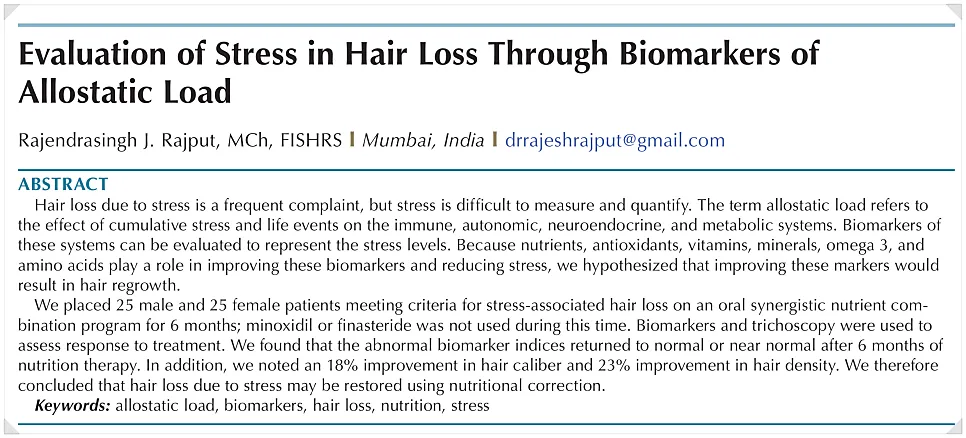
A recent study measured biomarkers that reflect this allostatic load and scientifically demonstrated the effect of stress on hair loss. It tried to objectively assess stress levels through various health indicators such as pulse, blood pressure, cholesterol, and fasting blood sugar.
A Study on Nutritional Supplements Taken for 6 Months
Dr. Rajendrasingh J. Rajput, who conducted the study, is a plastic surgeon who treats hair loss, including through hair transplantation. He has published many studies stating that the foundation of hair loss care is maintaining nutritional balance and improving lifestyle habits.
In the study introduced here, 25 men and 25 women whose hair loss was caused by stress were asked to take a specially formulated oral nutritional supplement for 6 months, instead of hair loss medications such as minoxidil or finasteride, and their changes were observed. The supplement contained several nutrients important for stress relief and hair health, including N-acetylcysteine, vitamin B12, biotin, and amino acids.
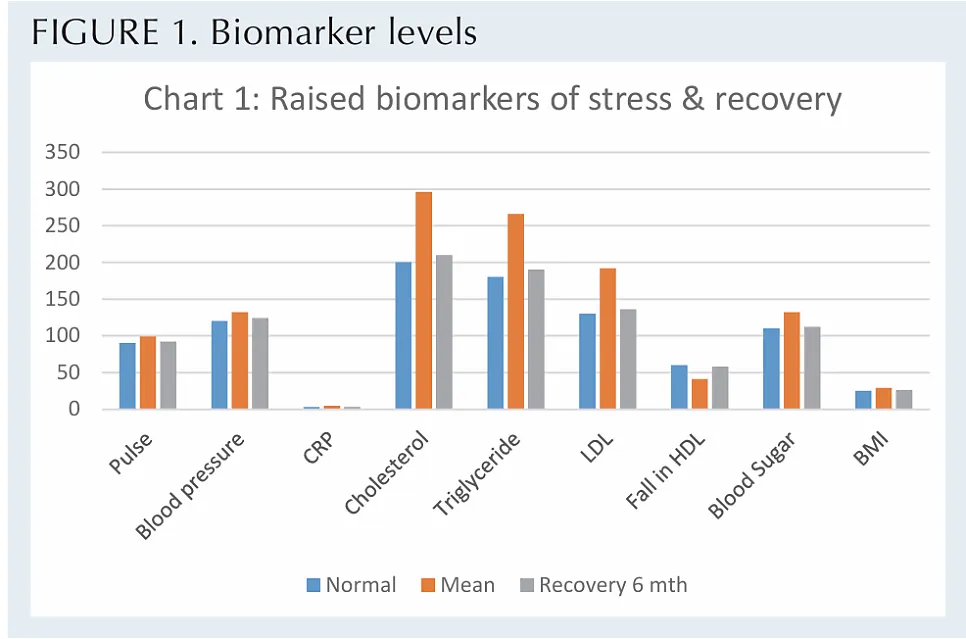
After 6 months, the biomarkers reflecting the participants' allostatic load had returned close to normal levels. Their hair condition also improved noticeably: hair thickness increased by 18%, and density improved by as much as 23%.
This shows that hair loss caused by stress is not simply a problem of the follicles, but is linked to a whole-body stress response. It also suggests that nutritional supplementation is very effective in addressing this issue. It is also worth noting that the same nutritional approach was applied to patients who experienced hair loss after COVID-19 infection or vaccination, and positive results were obtained.
Why Stress Worsens Nutritional Status
Why does stress worsen our nutritional status? When stress occurs, our body releases stress hormones such as cortisol to prepare for an emergency. To generate energy quickly, these hormones rapidly consume nutrients in the body. Stress also interferes with digestion and nutrient absorption, and drives us toward low-nutrient, high-calorie foods, which ultimately leaves the body in a serious state of nutritional imbalance.
In this regard, the study states that nutrients such as vitamin C, the vitamin B complex, magnesium, and omega-3 fatty acids play an important role in regulating stress hormones and stabilizing neurotransmitters.
A Signal Reflecting the Health of the Whole Body
According to the study, the stressors that cause allostatic load include environmental pollution, a competitive attitude toward life, all-night work, late-night culture, lack of sleep, exposure to bright screens, circadian rhythm imbalance, endocrine disruptors (environmental hormones), lack of exercise, and electromagnetic field exposure. The study also emphasizes that hair loss should not be viewed simply as a local problem, but should be taken as a signal reflecting the overall health of the body.
To manage stress, adequate rest and quality sleep, combined with a balanced diet and appropriate nutritional supplements, can be a way to regain healthy hair.
If you are currently struggling with stress-related hair loss, why not start today by making sure your body gets the nutrients it needs?
Reference: Rajput RJ. Evaluation of Stress in Hair Loss Through Biomarkers of Allostatic Load. Hair Transplant Forum International. 2022:44-46.


