
By Dr. Kim Narae · 2025.09.09
The Question I Hear Most in the Clinic
This is one of the questions I hear most in the clinic.
'Doctor, do I have to take hair loss medication for life?'
For acute conditions that pass quickly, such as a cold or enteritis, medication is taken for a week at most. But hair loss is a chronic condition that requires steady management, like high blood pressure or diabetes. So prescriptions are usually issued in units of three months or more.
The word 'lifelong' feels very heavy. So I tell patients, 'Rather than for life, think of it as taking it until it no longer bothers you, and it will feel easier.' Because there is no more realistic and effective way than medication to slow the progression of hair loss and protect your hair.
For Those Who Feel Burdened by Taking Medication
Finasteride has been recognized for its effectiveness in about 60 countries around the world since receiving FDA approval in the United States in 1997. Its effectiveness and safety have been sufficiently verified through many studies and real-world cases. However, recently more people seem to feel burdened by taking the medication itself. More and more people look for a topical spray (Pinjube) instead of an oral drug, or want to rely only on local injection therapy or hair transplant surgery, without drugs that are highly absorbed into the body.
Of course, some people are more vulnerable to hair loss when there are genetic factors or environmental triggers. So efforts to address the root cause, such as correcting lifestyle habits, are also important. However, when effectiveness, accessibility, and cost are all considered, taking hair loss medication remains the most realistic solution.
Japanese Study on Long-Term Use Over 10 Years
To ease concerns about long-term use of hair loss medication, I will explain with reference to a 2022 paper published in Japan on the 'safety and efficacy of long-term finasteride use for over 10 years.' The results of this study once again show how important it is to take the medication steadily for hair loss treatment.
The study was conducted on patients treated for male androgenetic alopecia at Tokyo Memorial Clinic, which has prescribed finasteride since 1999. It is considered even more meaningful because it was conducted on East Asians, such as Koreans.
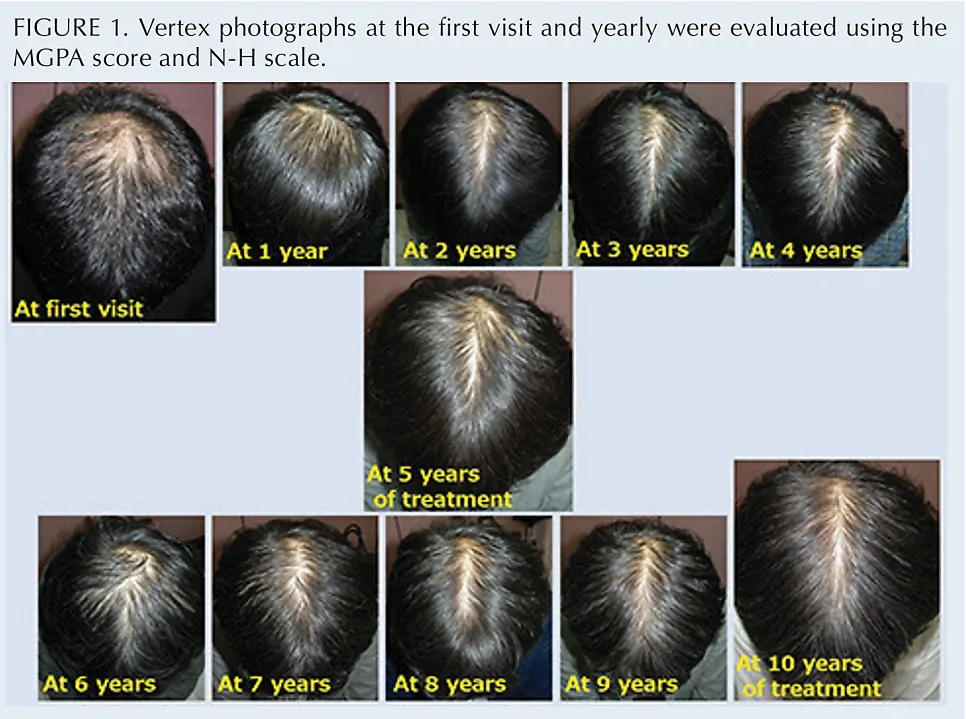
After prescribing finasteride 1 mg per day for androgenetic alopecia (AGA), photos of the forehead and crown were taken at each visit and compared to evaluate long-term effects, and the presence or absence of side effects was recorded to evaluate safety as well. The three studies were combined, conducted over 2.5 years (3,177 people), 5 years (801 people), and 10 years (532 people), respectively.
Treatment Effectiveness and Safety
The treatment effect based on progress photos (Modified Global Photographic Assessment (MGPA) Score) was 87.1% or higher, and the effect in suppressing progression was very high at 99.1% or higher. Greater improvement was seen in the group that started treatment in the early stage of hair loss (Norwood stages I to III) or was under 40 years old.
In terms of safety, the incidence of side effects was reported as low: 0.7% in the 2.5-year study and 6.8% in the 10-year study. Because no Post-Finasteride Syndrome (PFS) was observed in these studies, the results also show high safety. (Post-Finasteride Syndrome (PFS) is a term for symptoms that persist or newly appear even after stopping finasteride, a treatment for male-pattern hair loss.)
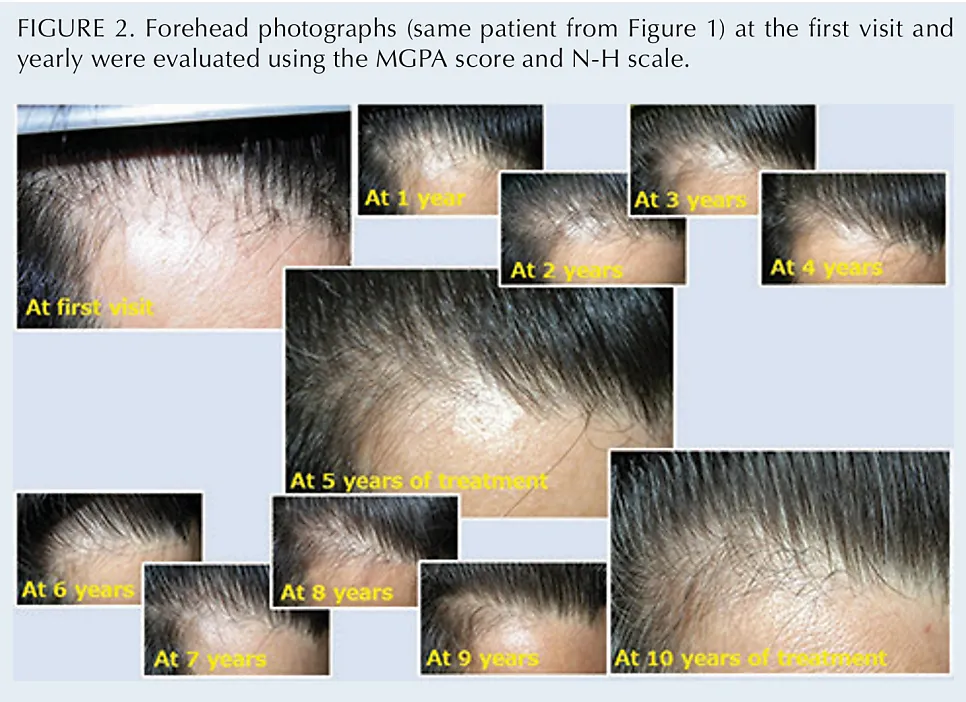
Compared with existing studies to date, this study shows an even higher treatment response, and according to the authors, because Japanese men's hair characteristics (thicker, black, and lower in density) make even small changes easy to detect, they show a better treatment response than studies on white men.
If Hair Loss Medication Feels Burdensome
Long-term use of hair loss medication for more than 10 years, namely taking 1 mg every day steadily, is a very effective and safe method for treating male androgenetic alopecia. Of course, sexual side effects or depressive feelings are occasionally reported, but most appear early in use and often recover after stopping.
Of course, the burden of the word 'lifelong' can be great. But as decades of accumulated research and real-world cases show, hair loss medication is a safe and effective way to manage hair loss. If oral medication is burdensome, there are options such as topical finasteride spray and various injection treatments. Since hair loss becomes harder to treat the longer it is left, if you suspect hair loss or it has already progressed, how about consulting a specialist and making a treatment plan to protect and improve your current hair condition?
References: Yanagisawa M, Sato A. Long-term (over 10 years) evaluation of efficacy and safety of finasteride in Japanese men with androgenetic alopecia: summary of three investigations. Hair Transplant Forum International. 2022;32(4):130-132


