By Dr. Kim Narae · 2025.08.19
Hair Loss From a Functional Medicine Perspective
In this post, we'd like to talk about hair loss from a functional medicine perspective. It approaches hair loss as a result of imbalances throughout the body, aiming to find the root cause and to treat, alleviate, or prevent it.
Hair loss is often thought to strike people who have a genetic predisposition to androgenetic alopecia or who are susceptible to hair loss. However, having such a predisposition does not mean everyone will experience hair loss, and I do not think it must simply be accepted. This is because genetic predisposition raises the risk of hair loss, but epigenetic factors that affect gene expression also play an important role.
Beyond androgens, the main culprit behind hair loss, various other mechanisms in the body also affect hair loss. Wouldn't we be able to become a little freer from hair loss if we understood these mechanisms more deeply?
Functional medicine goes beyond simply suppressing disease symptoms: it is a field that understands the body's complex systems in an integrated way and seeks the root cause to solve problems, and hair loss may also be the result of an overall imbalance in the body.
The topic of today's discussion is 'the role of reactive oxygen species in the mechanisms that cause hair loss, how dietary habits and environmental factors may affect it, and which nutrients are essential for hair growth,' and it refers to a paper by Dr. Rajput.
The Role of Reactive Oxygen Species in the Mechanism of Hair Loss
Reactive oxygen species (ROS) are by-products that normally arise in the metabolic processes of our cells, and they are substances the body needs. However, due to various environmental factors, ROS can be overproduced to a level that harms the body; these factors include lifestyle habits such as stress, heavy drinking, and overwork, and environmental factors such as food additives, pollutants, and ultraviolet rays.
Finasteride, the ingredient in the most representative hair loss medication we know of, inhibits the action of 5-alpha reductase, which prevents testosterone from being converted into DHT (dihydrotestosterone). However, DHT does not attack hair follicles directly; in the detailed mechanism, ROS play a large role, so the importance of lifestyle habits and diet to reduce these reactive oxygen species is emphasized here.
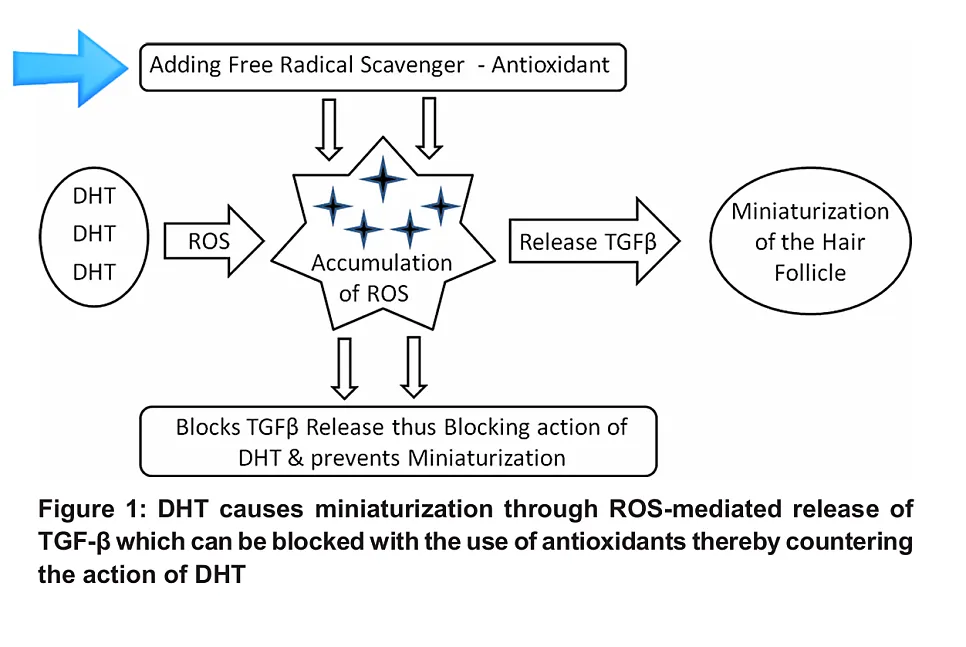
The schematic in Fig.1 explains it this way: 'the release of TGF-beta, which directly causes follicle miniaturization, is induced by DHT but is mediated through ROS, and if the ROS are removed (blue arrow: removing ROS that have built up with antioxidants blocks the mechanism that leads to hair loss), the release of TGF-beta is prevented, so hair loss does not occur even when DHT is present.'
Ways to reduce ROS include taking vitamins A, C, and E, eating foods rich in antioxidants, relieving stress, and getting good-quality sleep.
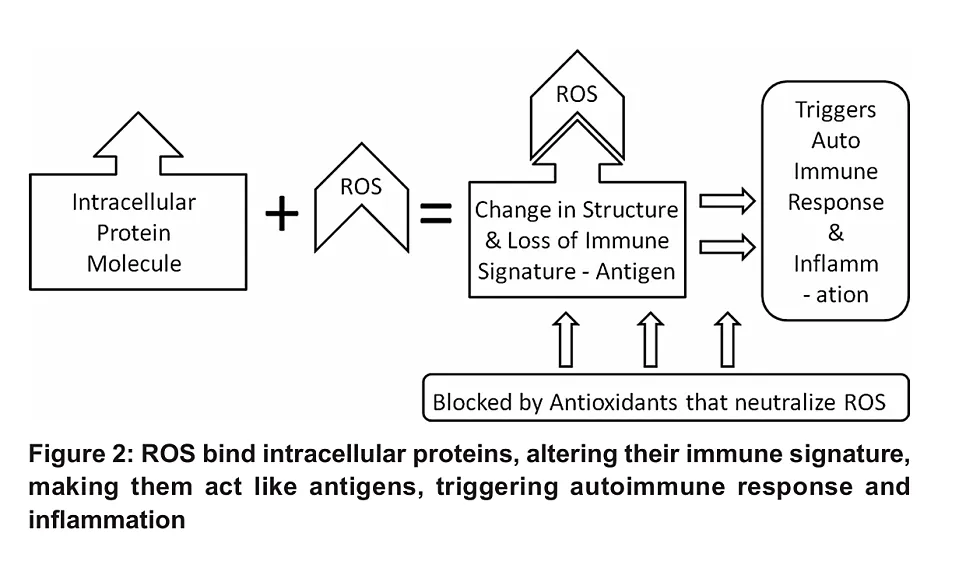
ROS can also bind to proteins inside cells (which the body then recognizes as antigens), causing autoimmune reactions and inflammation that can lead to hair loss, and antioxidants can prevent this by removing ROS. (Fig.2)
Besides antioxidants, omega-3 fatty acids, which have anti-inflammatory effects that reduce inflammation itself, and gamma-linolenic acid, a type of omega-6 fatty acid, are said to be the most powerful of the substances that naturally inhibit 5-alpha reductase, in addition to their anti-inflammatory effects.
Nutrients Important for Hair Growth
Next, nutrients important for hair growth include vitamin D, zinc, and iron. Vitamin D is essential for creating new hair follicles and plays an important role in regulating the hair growth cycle, and zinc, acting as an immunomodulator, is involved in suppressing the regression phase and entering the growth phase in the follicle cycle.
Iron is a particularly important nutrient for hair growth. Iron in the body is stored as a protein called ferritin, mostly in the liver, spleen, and bone marrow, but it is also stored throughout the body, including in scalp follicles, to be used when needed.
However, when blood iron levels fall and iron deficiency becomes possible, the body borrows iron from the iron storage organs in order of least importance to sustaining life, and at this point the hair follicles become a main target, and follicle growth stops as iron is lent out. When this happens, telogen effluvium can occur, and even if a blood test for iron deficiency shows normal blood iron levels, hair loss may already be progressing due to an iron shortage in the follicles.
Stem Cells and Nutritional Supply
Finally, the relationship between stem cells and nutritional supply also deserves attention. Follicular stem cells, which are important for hair growth, respond sensitively to whether the body's nutritional supply is sufficient or insufficient. On scalps with hair loss, stem cells may remain while progenitor cells are lacking, and adequate nutrients contribute to the proliferation and maintenance of these cells.
Understanding the Mechanism of Hair Loss
When a disease occurs, modern medicine treats the symptoms caused by that disease to prevent complications. And in many cases, even when a chronic disease occurs, if there is a family history, people often accept it, thinking genetic predisposition is the cause. However, a genetic predisposition does not necessarily have to show up as a disease, nor does it have to show up to the same degree.
In particular, hair loss is greatly affected by lifestyle habits and nutrition, so I believe it is important to deepen our understanding of the mechanisms of hair loss. For example, when dieting, if you know you are susceptible to hair loss, you can take steps such as increasing protein intake or taking nutrients essential for hair growth as supplements, to prevent hair loss or keep it from worsening.