
By Dr. Kim Narae · 2025.07.24
What Is Alopecia Areata?
Alopecia areata is a relatively common condition that occurs in about 2% of the population. As the name suggests, it usually involves hair falling out in round patches in one or a few spots on the scalp, and the lesions may appear in several places at the same time or merge into larger lesions. Depending on the pattern of hair loss, when all hair on the scalp is lost it is called alopecia totalis, and when hair is lost across the whole body including the scalp it is called alopecia universalis.
The most common case is that patients discover it while getting a haircut at a salon. When patients visit for a hair transplant consultation or hair loss treatment, I sometimes tell them whether they have alopecia areata while examining the entire scalp, including the back of the head. Because it is easily diagnosed clinically this way, in rare cases when needed, a biopsy is performed, and a blood test may be done to check for the presence of other autoimmune diseases.
Treatment of Alopecia Areata
Treatment may vary depending on the extent, speed of progression, and severity of alopecia areata. Steroid injections into the lesions every 2-4 weeks may lead to improvement within a few months, and depending on the case, steroids are given intravenously, or immunosuppressive and immunomodulating medication such as cyclosporine is taken.
Clinically, mild alopecia areata tends to have a high recovery rate, but in severe alopecia areata, the treatment effect may be low and the recurrence rate may be high. Also, for alopecia areata, hair transplant is in most cases not possible, so it is important to plan treatment carefully with a specialist from the beginning.
Medical treatment is important, but I also think it is important to prevent the condition by improving daily lifestyle habits, and even if you have a history of alopecia areata, to prevent recurrence by keeping your body healthy overall.
Lifestyle Habits That Increase the Risk of Alopecia Areata
Based on a paper published in the International Journal of Molecular Sciences in 2022, let's look at which lifestyle habits increase the risk of alopecia areata.
Lifestyle Factors Involved in the Pathogenesis of Alopecia Areata Minokawa, Y.; Sawada, Y.; Nakamura, M. Lifestyle Factors Involved in the Pathogenesis of Alopecia Areata. Int. J. Mol. Sci. 2022, 23, 1038. https://doi.org/10.3390/ijms23031038
The paper states that the exact cause of alopecia areata has not yet been determined, and some recent studies support that an autoimmune reaction is the cause. In addition, environmental factors are cited as major contributors, and this is said to include mental stress. However, since alopecia areata also occurs in newborns and infants, it says that factors that trigger onset other than mental stress, such as infection, toxins, and certain foods, should all be considered.
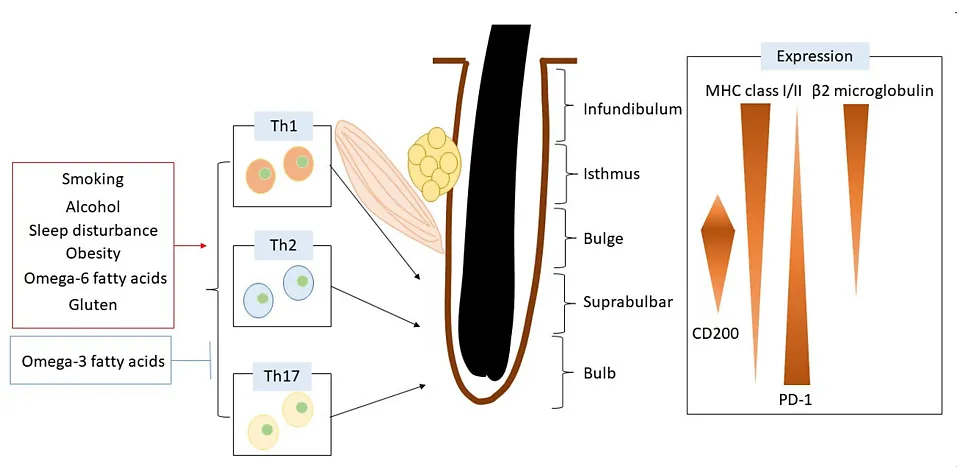
Healthy follicles are generally said to be an area with immunological privilege, where the expression of MHC class I and II can keep the follicle from presenting itself as an antigen to immune cells. Figure 1 conveys the idea that, despite this immunological privilege, various environmental factors such as lifestyle habits together break down this immune privilege, activating cells such as Th1, Th2, and Th17 and causing alopecia areata.
Now let's look at each of the lifestyle habits mentioned, one by one.
Smoking
First, smoking. It contains nicotine, which is known to be highly addictive. Besides nicotine, it contains various chemicals harmful to the body, which can cause inflammatory skin conditions or hair loss.
Combining the results of various studies, smokers have a 1.88 times higher incidence of alopecia areata than non-smokers, and the risk can increase further depending on the duration and amount smoked. It causes alopecia areata by activating the immune responses of Th17 and Th2 among the T-helper cells shown in Figure 1.
Alcohol
Second, alcohol. There are two opposing views on alcohol. First, the results suggest that regularly drinking alcohol may lower the risk of alopecia areata. The Hazard Ratio is 0.49; since a value below 1 means the factor (here, drinking) reduces disease risk, this means the risk for drinkers is about 51% lower than for non-drinkers. It is interpreted that moderate drinking can relieve stress, and as a result, it suppresses the secretion of cortisol, a stress hormone.
However, there is much research and evidence that drinking can worsen inflammation. In particular, in psoriasis patients, biopsies of lesions after drinking showed increased production of inflammatory cytokines (IFN-γ, TGF-α, Il-6), suggesting that alcohol may be linked to the immunological risks associated with alopecia areata.
Gluten Intake
Third, gluten intake. These days, in Korea there are apps that make it easy to find gluten-free restaurants for foreign tourists. Gluten is a protein derived from grains (wheat, barley, etc.) and is also known to trigger celiac disease. Celiac disease damages the intestinal mucosa and causes various autoimmune symptoms. Patients with celiac disease sometimes also have alopecia areata.
This gluten also plays a pathogenic role in worsening inflammatory skin conditions even in people who do not have the genes that develop into celiac disease. In one study introduced in the paper, when patients with celiac disease accompanied by alopecia areata were given a gluten-free diet, alopecia areata improved in 70.9% of patients.
The paper notes that gluten can strengthen all of the immune responses of Th1, Th2, and Th17 that attack follicles as shown in Figure 1, and concludes that gluten can worsen the follicle inflammation involved in the immunological pathogenesis of alopecia areata.
If Efforts to Improve Lifestyle Factors Add Up
As such, smoking, drinking, gluten intake, and also obesity and sleep disorders, which I did not mention separately, are major environmental factors related to the onset and worsening of alopecia areata. They contribute to alopecia areata by affecting immune responses and causing or worsening inflammation in the follicles.
Further research is still needed on the long-term effects of each factor. But even with the research so far, I wonder whether, if efforts to improve these lifestyle factors add up one by one, we can prevent the onset of alopecia areata, which is difficult to heal completely on its own and has a high recurrence rate.


