
By Dr. Park Sooho · 2025.07.20
The Hairline Takes Up More Than Half of the Face
When it comes to changing the contour of the face, cheekbone surgery or jaw surgery are probably the first things that come to mind. However, there is one area that takes up more than half of the face: the hairline. Including the sideburns, it actually takes up more than half of the face.
There are two main ways to correct a hairline that takes up such a large part of the facial contour: hair transplant and forehead reduction surgery. Each has clear advantages and disadvantages, so the more suitable method depends on the patient's condition.
When a Hair Transplant Is Enough
For most hairline corrections, a hair transplant is enough. This applies when filling in the M-shaped recessed areas, correcting the sides, or lowering the height a little.
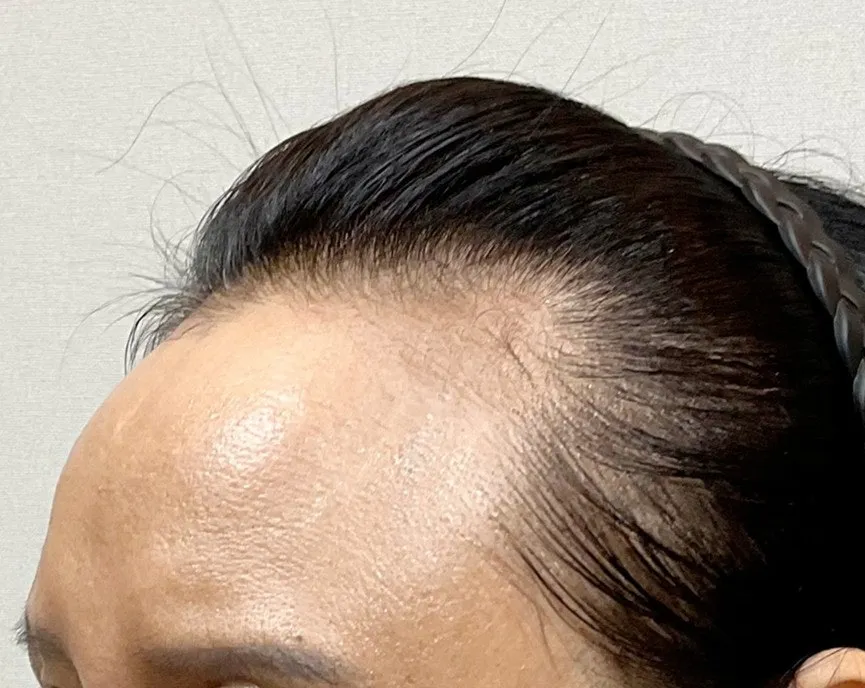
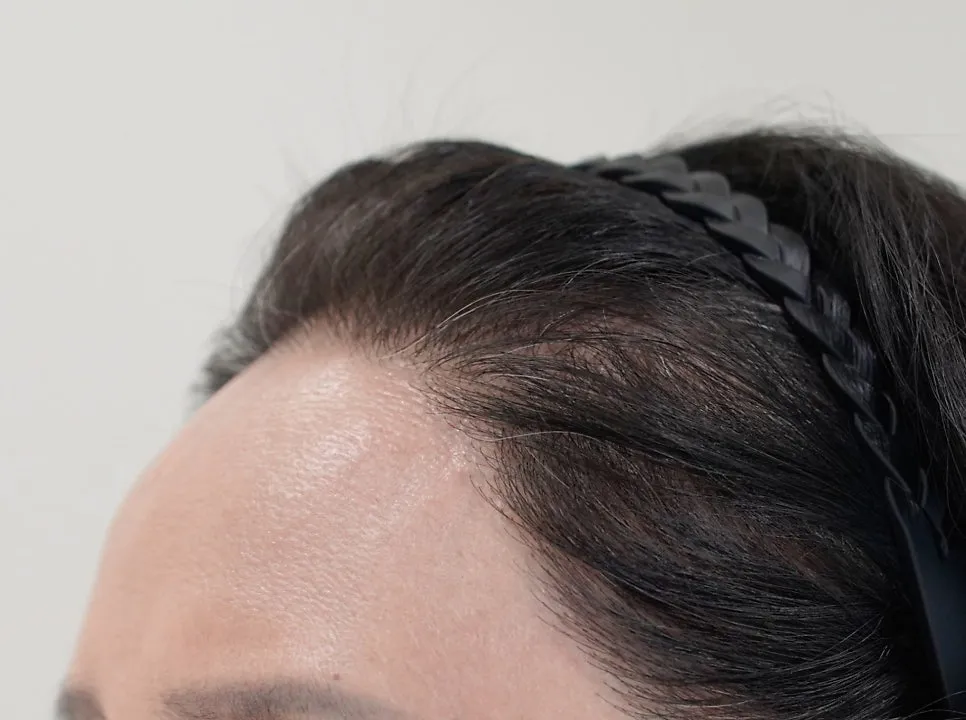
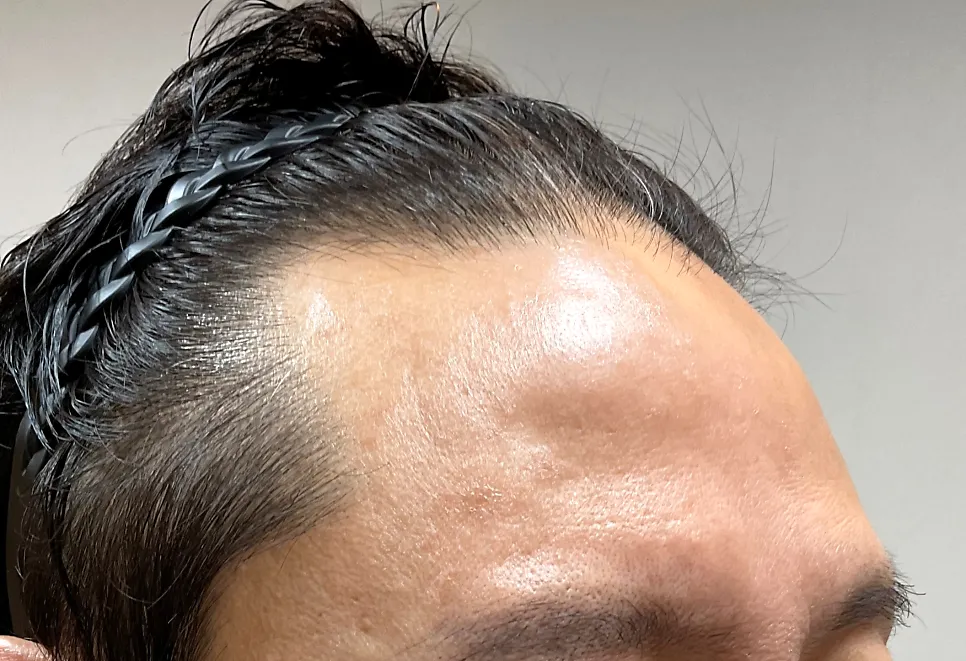
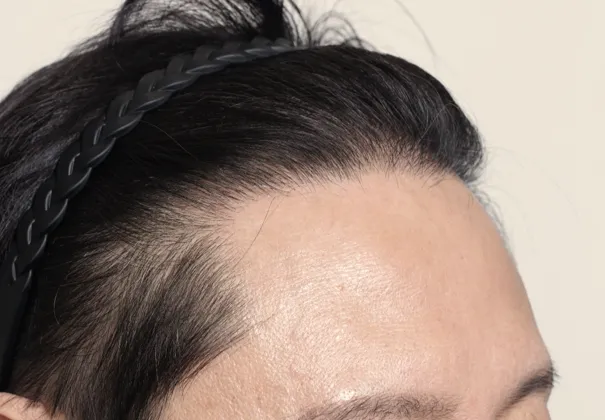
When the Forehead Height Needs to Be Reduced by 2cm or More: Forehead Reduction
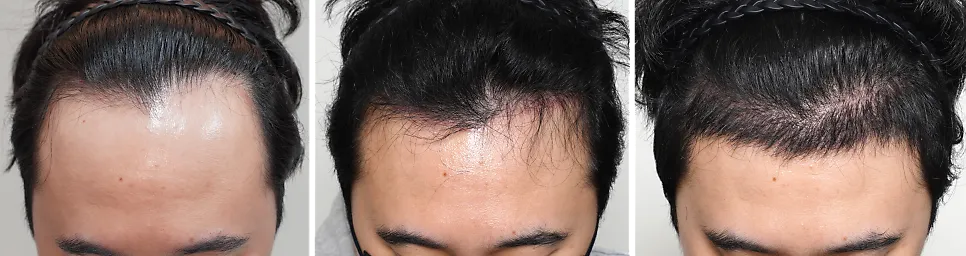
On the other hand, forehead reduction is better in some cases: when the forehead height needs to be reduced by 2cm or more. The reason is that if the height is reduced a lot with a hair transplant alone, the scalp in that area is likely to show through. The density that can be created with a transplant is inevitably lower than normal density, and in the part area, hair splits to both sides and does not overlap, so the scalp shows through even more. This is especially true for women, because their part is often closer to the center.
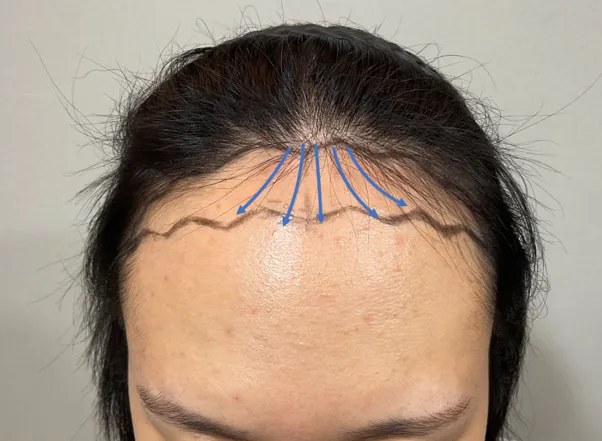
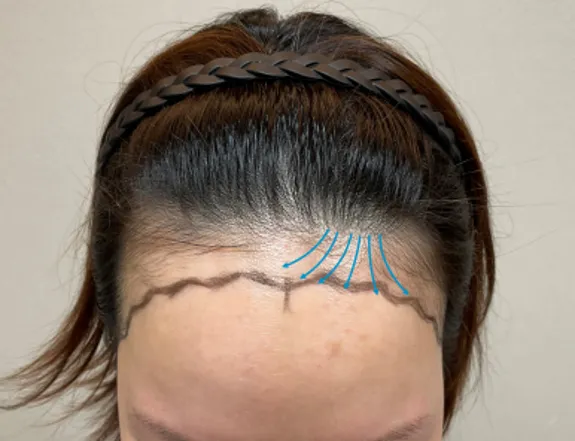
With forehead reduction, the hair comes down at nearly its original density, so the part is less likely to show through. Because the spacing between hairs widens as the scalp stretches, people who originally had lower density at the part may find the scalp shows through more than before the surgery, but in most cases the difference before and after is not noticeable.
If there is no M-shaped recession and the sides are not wide, forehead reduction alone may be enough. However, if the M-shaped recession and the sides also need to be reduced, a hair transplant is done 6 months after forehead reduction to complete the hairline. If only an area that does not overlap with the forehead reduction incision needs transplanting, such as the sideburns, forehead reduction and hair transplant can be done at the same time.
Why Forehead Reduction Scars Can Become Severe
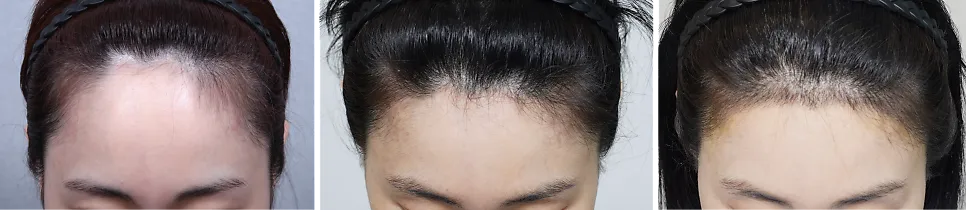
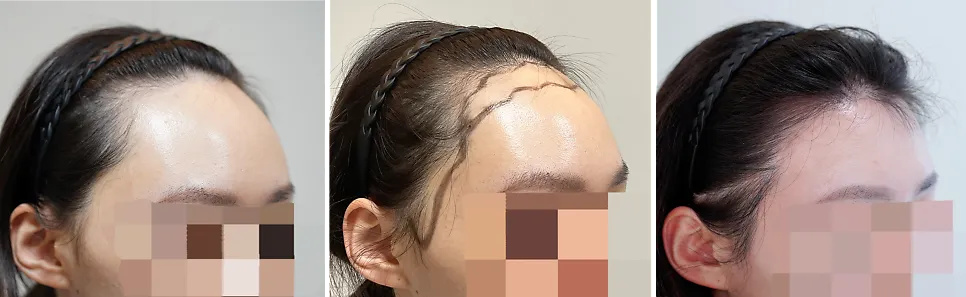
Forehead reduction scars are usually barely noticeable to others at conversation distance. Sometimes we see patients who come in because their scars remain severe after forehead reduction, and there can be several reasons for this.
This happens when the elasticity of the scalp is misjudged and the reduction amount is set too aggressively. This is largely due to a lack of experience.
This is when the incision fails to preserve existing hair, especially the fine hairs at the edge of the hairline. This is due to a limited understanding of the hairline.
This is when the galeal incision is performed inexpertly or not done at all, so the tension is not reduced sufficiently. A galeal incision makes it difficult to see the surgical field, and there is a high chance of injuring the blood vessels and follicles just beneath the galea, so some surgeons do not perform a galeal incision at all.
This is when the pulled-forward scalp is not firmly fixed to the skull. There are several ways to fix it, but I use Endotine because I think its fixation is excellent.
This is when each incised layer was not properly restored. This is a lack of care. Sometimes tension is applied during skin closure. Skin closure should be done with all tension on the skin completely removed. If the skin surface is not aligned smoothly (it is a matter of attentiveness), the scar may become larger.
If these basics are followed well, a large scar is very unlikely to remain. Even so, if the scar bothers you even a little, it can be addressed with a hair transplant over the scar.
Forehead Reduction When There Is Not Enough Hair at the Back of the Head
There are also cases where forehead reduction is needed even if the forehead height is not reduced by very much. Usually, when the forehead height is reduced by 1.5cm or less, a hair transplant is often enough, but forehead reduction first can also help when there is not enough hair at the back of the head. Such cases are when, even after several hair transplants, the forehead remains high, or the original forehead is very wide and the hair at the back of the head is insufficient to achieve the hairline height you want.
A forehead reduction of about 2cm can save roughly 2,000 to 3,000 hairs. Afterwards, the saved hairs can be used to lower the hairline a bit more or to fill in areas where density is lacking.
Discomfort After Forehead Reduction
One thing patients find uncomfortable after forehead reduction is the loss of sensation in the frontal area, which happens because the sensory nerves going to the scalp are cut. Most of the sensation returns after about 6 months. Rarely, concurrent shedding, in which hair in the frontal area falls out, can occur, but this also starts to grow back after about 3 months, and eventually it recovers. The scar is as I mentioned earlier.
Choosing the First Surgery Is Important
People with wide foreheads often spend their whole lives covering their foreheads and experience a lot of inconvenience. Once they have a narrow, pretty forehead, many say they are glad they look better, but they especially appreciate that daily life has become easier. Many say it is the best thing they have ever done (for me, the best surgery I have had so far is LASIK). When they now tell me that they are so comfortable even on windy days and thank me, I feel really happy and think that I did well to take on this work.
I hope that fellow doctors reading this, when they meet patients concerned about a wide forehead, will help them choose the more suitable of the two surgeries. Since each approach has a method that suits each person better, how you choose the first surgery is really important. Changing the order not only means taking a longer route, but may also make it impossible to achieve the best results.
※ This article was published in the vol. 93 issue of [Ophthalmologist], published by the Ophthalmologists' Association. ※ All photos on this blog are taken and used with the patient's consent. ※ Side effects such as pain, swelling, bleeding, infection, and scarring may occur after a hair transplant or forehead reduction.


