By Dr. Kim Narae · 2025.07.02
Complaints of Losing Weight but Losing Hair Too

Wegovy, a powerful appetite-suppressing anti-obesity medication, remains very popular. In particular, for people with severe obesity, it has become a welcome aid for essential weight loss, not only for cosmetic purposes but also from a health standpoint.
Perhaps because summer is approaching? In recent consultations on hair loss in our clinic, there are increasing complaints from people dieting with Wegovy or other weight loss methods, such as “I lost weight, but my hair is falling out too.”
So in this post, I will look at how Wegovy in particular is related to hair loss, and how hair loss can be prevented.
How Wegovy Works and Its Side Effects
Wegovy is an anti-obesity medication made by Novo Nordisk of Denmark. Its ingredient is semaglutide, and it is a GLP-1 (glucagon-like peptide-1 receptor agonist) analogue injection. It works by stimulating the satiety center in the brain, delaying gastric emptying, and regulating blood sugar, which produces a weight loss effect.
However, every medication comes with side effects. Wegovy has generally been reported to cause nausea, vomiting, diarrhea, constipation, headache, fatigue, and similar symptoms. On top of that, and more seriously, reports of gallbladder inflammation, pancreatitis, hair loss, and, more recently, vision-related side effects have been coming in one after another, and research on these reports is still ongoing.
Now, here is what you are probably most curious about.
The Relationship Between Hair Loss and Wegovy
The Truth About Wegovy and Hair Loss, From a Hair Transplant Specialist
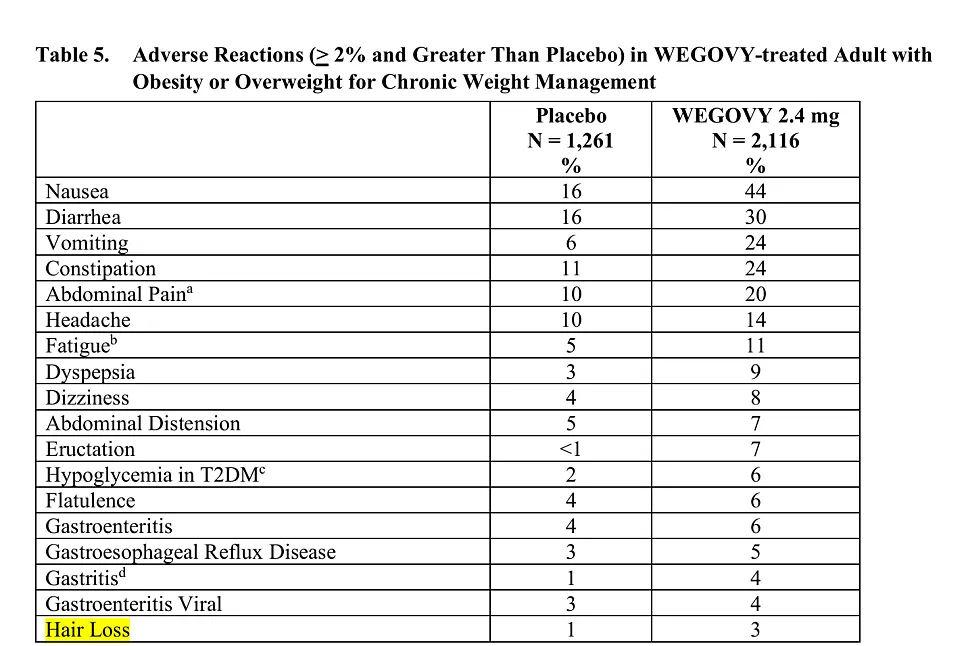
The table shown above is excerpted from Wegovy's official patient medication guide.
The table lists side effects that occurred 3% or more more often in the Wegovy group than in people who received a placebo (a fake medication). For hair loss, this means that 1% of the placebo group and 3% of the Wegovy group experienced hair loss.
The official clinical report also mentions it as a “common” side effect on par with nausea and vomiting. In a study of adolescents aged 12 and older, hair loss occurred in 4% of those using Wegovy, while none was reported in the placebo group.
Why Does Rapid Weight Loss Cause Hair Loss?
Although more research is still needed on the link between Wegovy and hair loss, it is currently more reasonable, in my view, to interpret it as a secondary phenomenon that appears when body weight suddenly drops, rather than a side effect of the drug itself.
Our bodies perceive rapid changes in weight, especially fast weight loss, as physiological stress. As a result, hair stops growing and shifts into the resting phase, and after a certain period, a form of hair loss called telogen effluvium appears, in which a large amount of hair suddenly falls out.
In addition, when Wegovy is used, food intake drops sharply, which makes it easy to become deficient in nutrients essential for hair growth, such as protein, iron, zinc, and B vitamins, and this eventually leads to hair loss.
Telogen Effluvium Also Commonly Occurs After Weight-Loss Surgery
This kind of hair loss pattern also commonly occurs after weight-loss surgeries such as gastric banding and sleeve gastrectomy. Sleeve gastrectomy may be considered a rather extreme form of obesity treatment: it leaves the stomach in a banana-shaped tube by removing the large portion of the stomach, and it induces weight loss by affecting food intake and appetite-regulating hormones.
But as with any trade-off, many studies have already reported that telogen hair loss occurs in a certain proportion of patients after weight-loss surgery.
In particular, one study conducted in Spain found that as many as 41% of female patients who underwent sleeve gastrectomy experienced hair loss between 3 and 12 months after surgery. In that study, blood levels of zinc and iron were measured to check whether the telogen hair loss was caused by nutrient deficiency.
The results were interesting. When the combined value of zinc and iron levels was below 115, the risk of hair loss was reported to increase by more than four times. Even when each level is within the normal range, a low combined total of iron and zinc suggests a higher likelihood of hair loss, which is a clinically meaningful result.
Hair Growth, Zinc, and Iron
Zinc is an important trace mineral involved in the division of hair follicle cells and in protein synthesis. When it is insufficient, growing hair can shift into the resting phase, and hair loss may begin after a certain period. Zinc is also known to be involved in preventing alopecia areata through antioxidant action and immune regulation.
Iron is a major component of hemoglobin and delivers oxygen and nutrients to hair follicle cells. Dermal papilla cells are a tissue with very active metabolism, so when oxygen is insufficient, their growth slows or stops and they eventually shift into the resting phase. For this reason, iron deficiency is also an important cause of hair loss.
What to Do About Hair Loss Caused by Wegovy?
In conclusion, to prevent hair loss while using Wegovy, there are several factors that must be managed. First, sufficient protein intake is essential. About 1.2 to 1.5 grams of protein per kilogram of body weight is needed; for example, for an adult weighing 60 kg, a daily intake of 70 to 90 grams of protein is recommended.
In addition to protein, you should get enough iron, zinc, B vitamins, vitamin D, and other nutrients that can become insufficient as food intake decreases, through food or supplements. Taking a multivitamin or a hair supplement can also be one option.
Most importantly, do not set the pace of weight loss too fast. Maintaining a gradual rate of weight loss of about 0.5 to 1 kg per week helps protect hair health.
If Hair Loss Has Already Started
With telogen hair loss, hair can recover naturally once the cause of the hair loss is removed, so even if hair loss has already started, you do not need to worry too much.
Instead, if you consult a specialist as early as possible and discuss an accurate diagnosis and appropriate treatment, recovery can be faster and a higher rate of recovery can be achieved.
In conclusion, hair loss during Wegovy injections can be managed and can also be prevented, so if you are planning to use Wegovy or are already using it, please also consider your hair health through this post.
Reference: Cao P, et al. Hair Loss After Metabolic and Bariatric Surgery: a Systematic Review and Meta-analysis. Obes Surg. 2021. doi:10.1007/s11695-021-05311-2. Ruis‑Tovar JA, et al. Hair loss in females after sleeve gastrectomy: predictive value of serum zinc and iron levels. Obes Surg. 2018;28(12):3929–3934. doi:10.1007/s11695-018-3433-3.