By Dr. Kim Narae · 2025.06.11
A Study of Nine Pairs of Identical Twins
Do you remember the twin photo story I shared last time? Today I will look at that study again and briefly explain how important taking medication is.
This paper was published in 2002, more than 20 years ago. Its title is “Finasteride improves male pattern hair loss in a randomized study in identical twins.” It may look modest by today's standards, but it is a fairly impactful study in the history of hair loss research.
This study was conducted with nine pairs of identical twins. Of two people with the same genes, one took finasteride and the other took a placebo for one year, and the results were quite striking.
Above all, the study was conducted as a double-blind study, which makes it highly reliable. This means that neither the participants nor the researchers knew who was taking the real medication and who was taking the placebo.
Results After One Year
The results after one year were clear. The twins who took finasteride showed a statistically significant increase in hair density compared with those who took the placebo, and hair thickness also improved considerably. The analysis of clinical photographs also showed a clear difference between the two groups, so the effect of the medication could be seen directly.
In particular, progression of hair loss was noticeably suppressed in the finasteride group, which shows that finasteride is a very effective choice for treating male pattern hair loss. The study also reported no notable drug side effects during the study period, which supports the view that finasteride is a treatment that can be used safely.
If These Two Had Come In for a Consultation
If these two people had come in for a consultation at a clinic specializing in hair loss treatment and hair transplantation, how would the consultation results differ?
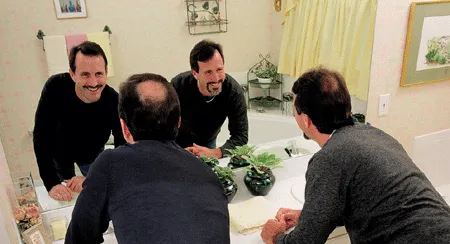
First, the person on the left, who did not take hair loss medication.
“Because hair loss at the crown is progressing, the ‘safe donor area’ at the back of the head, from which hair can be harvested, is becoming narrower. The position of your hair whorl is not especially high, so if medication is not taken and things are left as they are, the donor area at the back of the head will not be enough to fill the advanced hair loss area. You have a lot of facial hair, so beard hair could be used as a source for transplantation, but if you take the medication consistently, you can expect a much more successful treatment outcome. I recommend starting the medication from today. After the transplant, we also recommend additional injection treatment or minoxidil for the areas where hair has thinned. (This varies with head size.) The transplant estimate for the crown alone is roughly 4,000 hairs.”
On the other hand, for the person on the right, who took the medication, I first offer encouragement: “You have been taking your medication well.”
“The effect of the medication is usually most noticeable within one to two years, so now is the time to consider a hair transplant. The expected number of transplanted follicles will be fewer than roughly 2,000, and please remember that continuing the medication remains important. Medication does not stop hair loss completely; it slows its progress, so its effect may decrease slightly over time. In that case, we can switch the medication to Avodart (dutasteride), or recommend additional injection treatment together with taking oral minoxidil, and it is good to continue hair care consistently after the transplant.”
Of course, since the people in these photos are identical twins who took part in the study, the story would change once the other twin also begins taking medication. Still, the photos clearly highlight how important consistent medication use is.
The “Choice” to Find the Treatment That Fits You
At every moment of life, we stand at a crossroads of choices. If you have put off a consultation thinking, “Do I have to take it for life…?” or “It's hereditary, so can anything really change?”, now is the time to make a “choice” to understand your own condition accurately and find the treatment that suits you. Your confidence as you start the day in front of the mirror will change.
Reference: Dow B, Stough D. Finasteride improves male pattern hair loss in a randomized study in identical twins. J Dermatol Treat. 2002;13(4):243-246.