By Dr. Shin Seungkyu · 2024.02.28
Lifestyle Habits That May Make Alopecia Areata More Likely
Many of us may have experienced alopecia areata at least once in our lives, but its cause has not been clearly identified. So recently I read a paper on lifestyle habits that may make alopecia areata more likely, and I would like to share it with you.
Most of the paper's content deals with molecular biological mechanisms, so it is somewhat difficult and may not be very helpful in daily life. Still, I think it's good to know the broad outlines.
What Is Alopecia Areata?
Alopecia areata is an autoimmune disease in which one's own immune cells attack one's own hair follicles, causing non-scarring hair loss (non scarring hair loss) that characteristically appears as round patches on the scalp. It most commonly occurs between the ages of 10 and 25.
The exact cause is unknown, but it is thought to occur when an autoimmune response attacks the hair follicles, and psychological stress has been suggested as an environmental factor. At least 23% of patients are said to have experienced an emotional event or crisis before developing alopecia areata. However, since alopecia areata is also observed in newborns and infants, psychological stress alone does not seem to explain it.
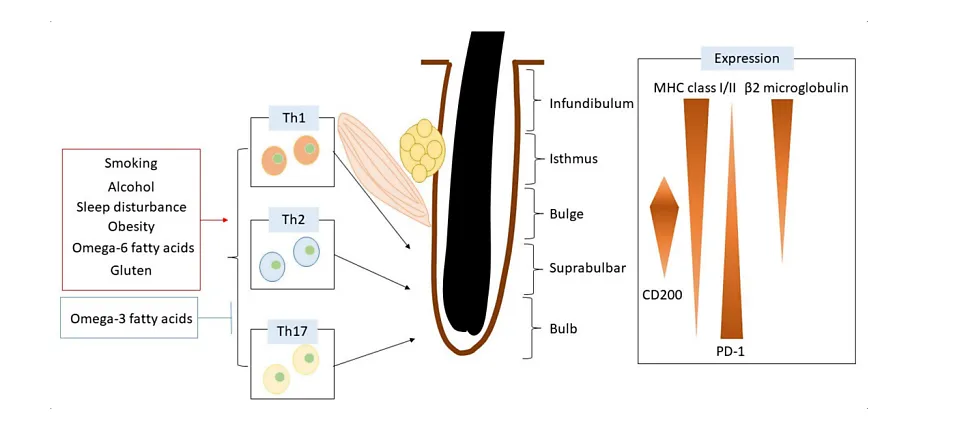
This figure shows the structure of the hair follicle and the immune-response mediators related to various lifestyle habits.
Smoking and Drinking
The first lifestyle habit to look at is smoking. Cigarettes contain nicotine, which is highly addictive, and it is well known that they harm health. Continued smoking can cause inflammatory skin diseases and may lead to alopecia areata. Smoking is said to affect Th17 and Th2 (which is associated with atopic dermatitis) shown in the figure above. Exposure to secondhand smoke in childhood carries a risk of atopic dermatitis, so family cooperation is important.
The second is drinking. According to several statistical analyses, alcohol is known to be an important factor in the onset of alopecia areata. Alcohol is also said to affect Th17, worsening skin inflammation and possibly causing atopic dermatitis or psoriasis. Aldehyde, a byproduct of alcohol, also increases histamine release from mast cells, causing skin itching and inflammation.
Sleep Disorders and Obesity
The third is sleep disorders. Sleep disorders such as sleep apnea and insomnia are also risk factors for alopecia areata, and they can also be risk factors for autoimmune diseases such as rheumatoid arthritis and Hashimoto's thyroiditis. Among patients with alopecia areata, 11.4% reportedly experienced excessively long daytime sleep. Sleep disorders can also reduce the physiological function of the skin, causing dryness and itching.
The fourth is obesity. According to several clinical data, obesity contributes to the development of several autoimmune diseases, including alopecia areata. Obesity also affects the Th2 and Th17 immune processes, becoming a risk factor for atopic dermatitis. It is said that for every 1-point increase in BMI, the risk of atopic dermatitis rises by 2%.
Fatty Acids and Gluten
The fifth is fatty acids. Fatty acids are major structural components of cell membranes and regulate signaling pathways between cells. Among the major fatty acids, omega-3 fatty acids are said to reduce the risk of inflammatory diseases. In contrast, omega-6 fatty acids can trigger inflammatory skin diseases. Taking omega-3 fatty acids daily is said to help prevent alopecia areata.
The sixth is gluten. Gluten is a protein found in the grains and seeds of cereal plants, and it is known to increase allergic immune reactions and cause celiac disease. In patients with alopecia areata who also have celiac disease, alopecia areata improved in 70.9% of those who followed a gluten-free diet.
Improving Individual Lifestyle Habits
We have kept explanations of the molecular biological processes by which lifestyle affects alopecia areata to a minimum, and instead introduced the parts that may be helpful.
Alopecia areata goes through various immune states depending on the individual during its clinical course, so I believe improving each person's lifestyle habits helps. Also, maintaining a healthy way of life reduces psychological stress, which is known to be the biggest cause of alopecia areata.