
By Dr. Park Sooho · 2024.01.28
Is it possible to transplant hair to look like baby hairs?
Many patients who come in for consultation show photos of celebrities with beautiful baby hairs, such as IU, Jennie, and Kim Yuna. Is it possible to transplant hair to look like baby hairs?
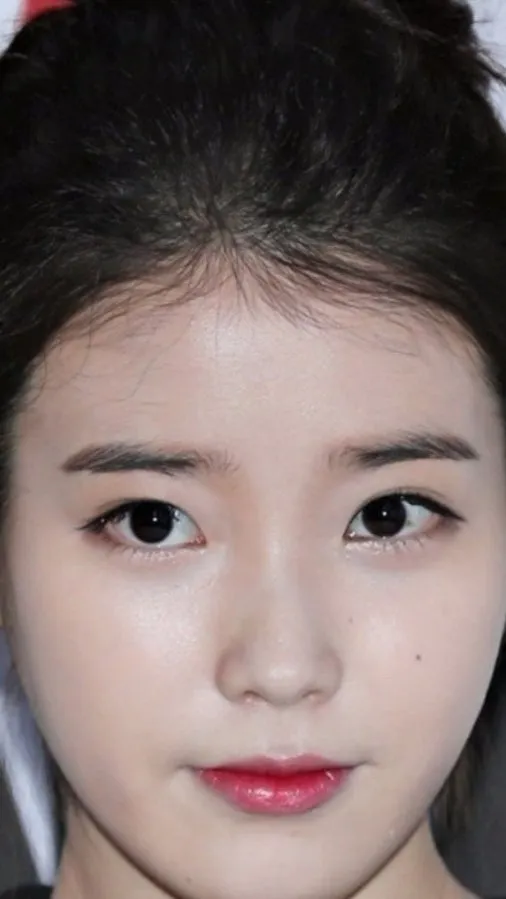

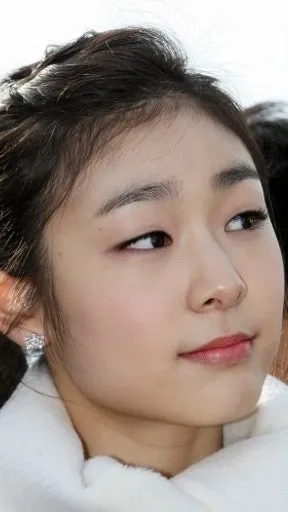
To answer directly, baby hairs can be transplanted, but realistically, it is difficult to achieve the look in the photos above through baby hair transplant.
Why real baby hairs are difficult to transplant
The reason is that to create baby hairs like those in the photos above, hundreds of baby hairs must be transplanted. "Real" baby hairs, as opposed to thin hairs, can only be harvested from the nape or the M-shaped area of the forehead. If hundreds are harvested from the nape, scarring will be visible, and if hundreds are harvested from the M-shaped area, it becomes impossible to transplant into the M-shaped area itself (the holes made by non-incisional harvesting are larger than the follicles to be transplanted, so grafts placed there would be loose). Even if you take all of this into account and harvest and transplant hundreds of real baby hairs, the graft survival rate of the baby hairs themselves drops significantly (and the result is likely to be sparse and look like Gollum).
For these reasons, we do not perform baby hair transplants. We also perform many forehead reduction surgeries, and because the baby hairs on the scalp removed during forehead reduction seemed too valuable to discard, we separated all of them and tried transplanting them a few times. However, the graft survival was poor, and the hairline ended up appearing much higher than expected.
Creating a gradation with thin hairs
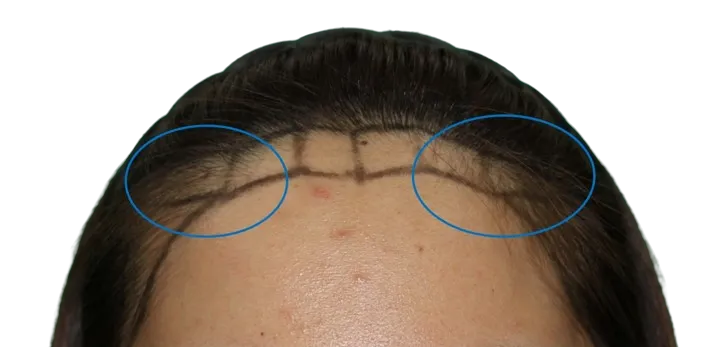
However, we cannot give up on a natural hairline. Although it is difficult to transplant real baby hairs, we select the thinnest hairs from those harvested from the back of the head, place them toward the front, and create a gradation so that the density gradually increases, aiming to make them look as much like baby hairs as possible.
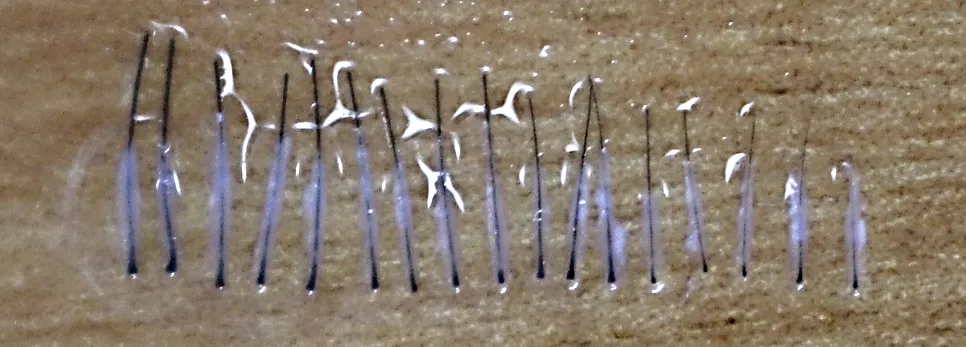
The photo above shows hair from a single person, and the thickness varies widely.
To transplant as many thin hairs as possible toward the front, with incisional harvesting we pick out and set aside thin hairs until the end of the surgery, then transplant them at the very front last.
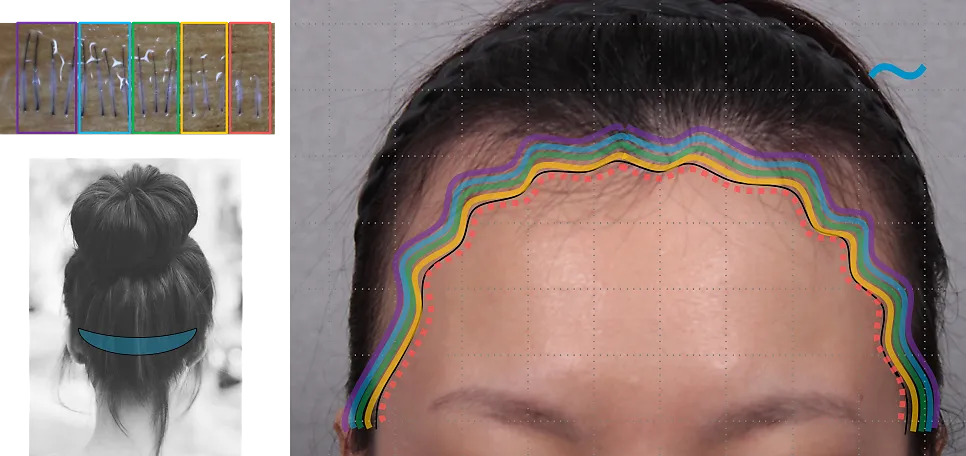
With non-incisional harvesting, we harvest starting from areas closer to the nape, and transplant those follicles at the very front.
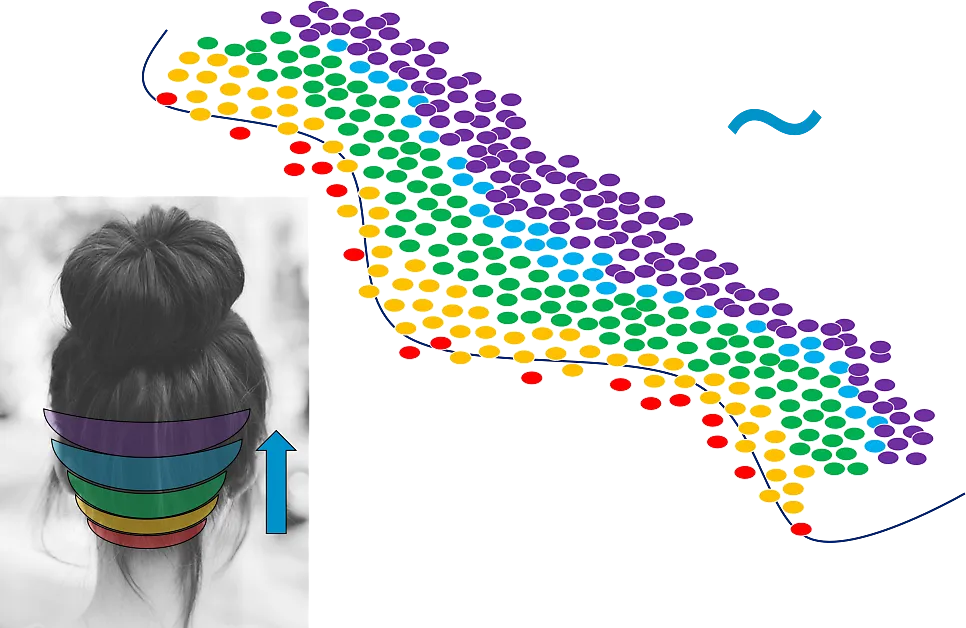
I used rainbow colors so the sections are easy to distinguish, so it looks a bit flashy.
Depending on existing baby hairs and hair thickness
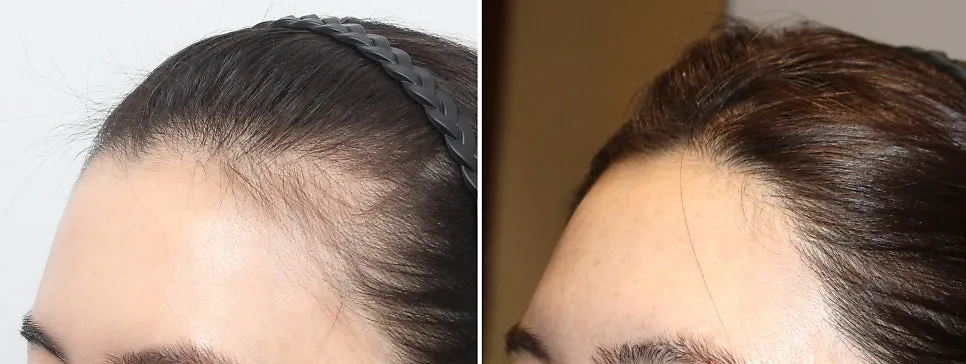
As in the photos below, for those who already have baby hairs, we preserve the existing baby hairs as much as possible.
As in the photos below, for those who need transplantation further forward than the existing baby hairs and whose hair is thick, we emphasize the gradation effect through the curvature of the hairline and differences in density.
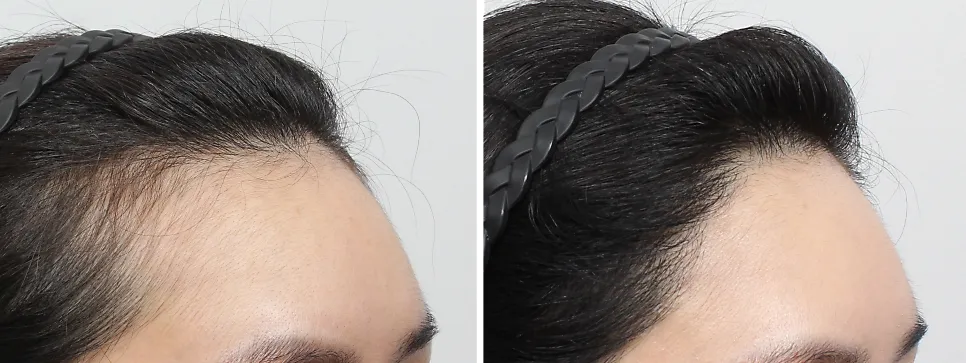
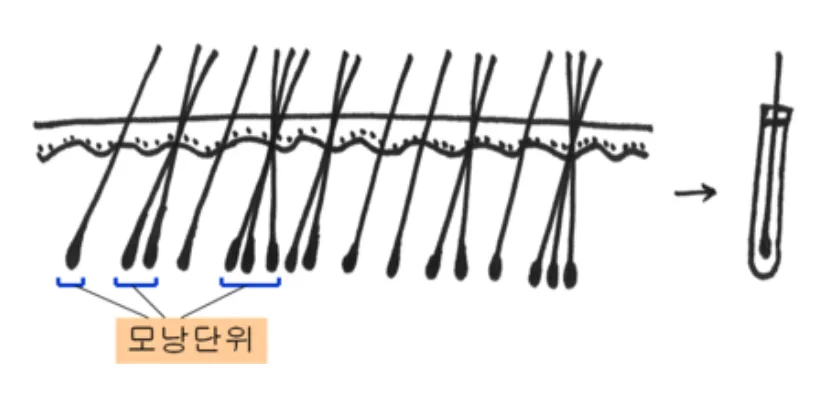
Human follicles often occur in follicular units of two to three follicles grouped together. For female hairline transplantation, two- or three-follicle units are separated into single-follicle single hairs for use. In particular, when correcting the sides and sideburns, the proportion of single hairs can exceed 70%.
Thinning hair with a hair removal laser
Lastly, the transplanted hair can also be thinned with a hair removal laser. However, this method involves some hit-or-miss, so unless the case is very severe, we do not strongly recommend it. Some hairs do become thinner with a hair removal laser, but hairs in unwanted areas may also disappear (of course, this depends on the practitioner's experience and skill). Even if it looks slightly unnatural after transplantation, in most cases, if we create a little more curvature in the hairline, or harvest mainly thin hairs and lightly place them at the front of the hairline, it becomes quite natural.
What styles are possible after surgery
I would like to share my personal thoughts on baby hair transplants, because I hope you won't be too swayed by the term itself.
If there are very few existing baby hairs and the hair is thick, a slicked-back style may be difficult even if the gradation turns out well. At the same time, I can confidently say that you won't have to worry about it even on windy days.
You need to know exactly which styles will be possible after surgery in order to decide on the surgery properly and to anticipate how you will look afterward. When consulting about a hairline transplant, it is also good to first ask what styles can look natural based on whether you have baby hairs and how thick your back hair is.
※ Hair transplant surgery may cause side effects such as pain, bleeding, swelling, and inflammation.


