
By Dr. Park Sooho · 2024.01.21
When more than 2 cm needs to be reduced, forehead reduction
Forehead reduction surgery is a good option for people with a high forehead. If the forehead height needs to be lowered by more than 2 cm through hair transplant, I recommend forehead reduction instead. This is because lowering the height too much with hair transplant alone can make the density at the parting look low. The parting of women is closer to the center of the face, so it is more noticeable than in men.
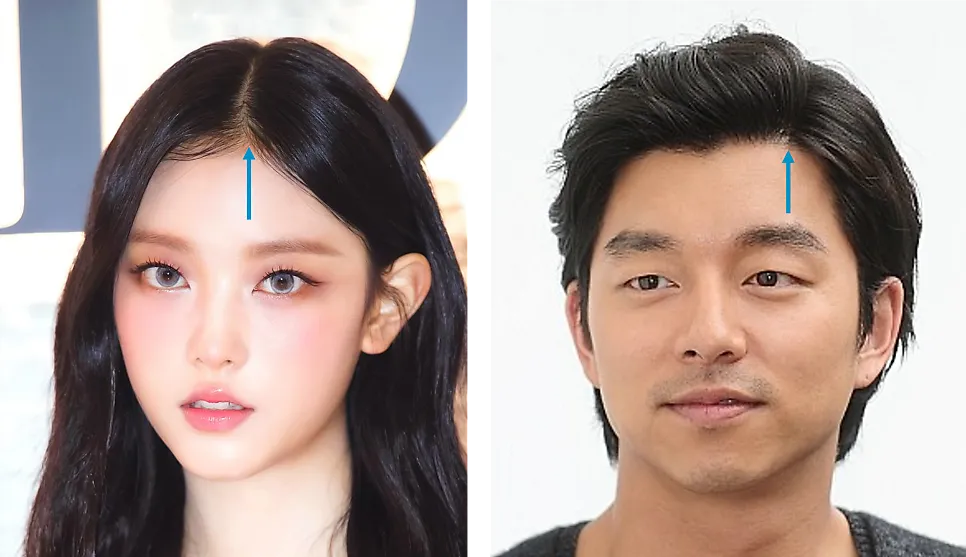
The density that can be achieved with hair transplant is inevitably lower than natural density. And at the parting, where hairs do not overlap and split apart, the density looks even more sparse.
So when the forehead height needs to be lowered significantly, as in the photo below, I think forehead reduction surgery is better, since it narrows the forehead while maintaining the existing hair density.
Design to Reduce 2.5cm
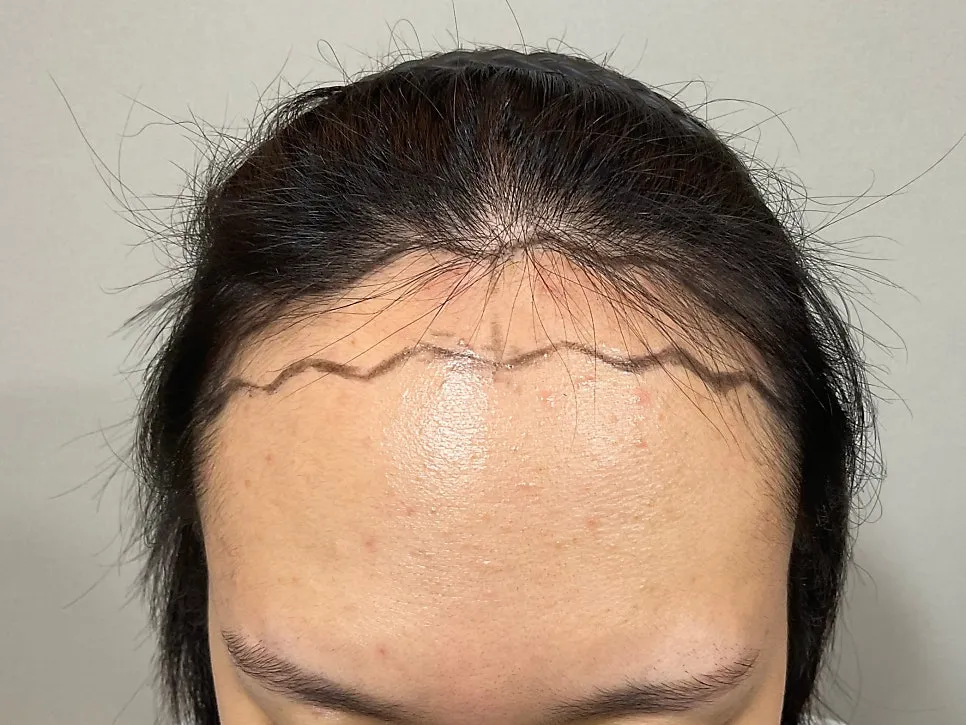
The design above is for a forehead reduction that lowers the forehead height by 2.5 cm. If you try to fill in the entire design above with hair transplant, the hair may split apart and the parting may look empty, as in the photo below.
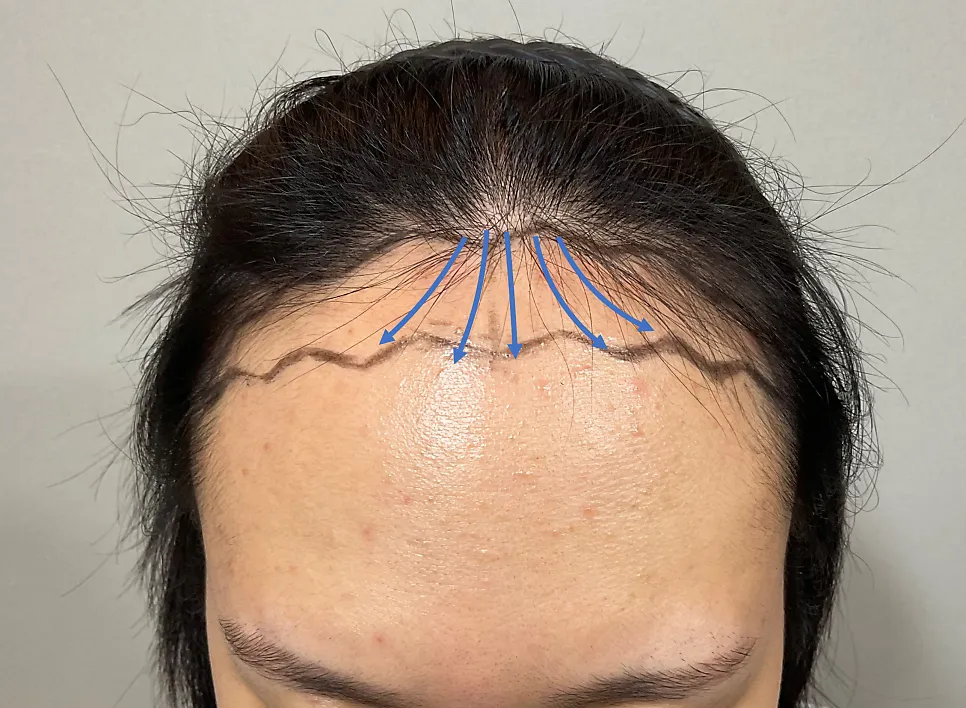
If you first lower about 2.5 cm with forehead reduction, you can save roughly 2,500 to 3,000 hairs that would otherwise be needed for hair transplant. First lowering the height with forehead reduction and then tidying the sides with hair transplant is the best approach. If the M-shape or sides are not wide, or if there are many baby hairs in the M-shaped area, forehead reduction alone is sufficient.
Height that can be reduced with forehead reduction
So how much can forehead reduction lower the forehead height? It varies from person to person, but with average elasticity, about 2 cm can be removed. With good elasticity, more than 3 cm is possible, and conversely, with limited elasticity even 1.5 cm may be difficult.
Pre-surgery diagnosis is important for creating an accurate surgical plan on how many centimeters to remove. The patient above was told at another clinic that only 2 cm could be removed, but when we checked the scalp's elasticity, we determined that at least 2.5 cm could be removed.
We first told the patient 2.5 cm, but designed the plan so that we could lower it a little more if there was room during surgery. While checking during surgery, we found there was enough elasticity, so we lowered it 0.3 cm more than the pre-surgery design, a total of 2.8 cm.
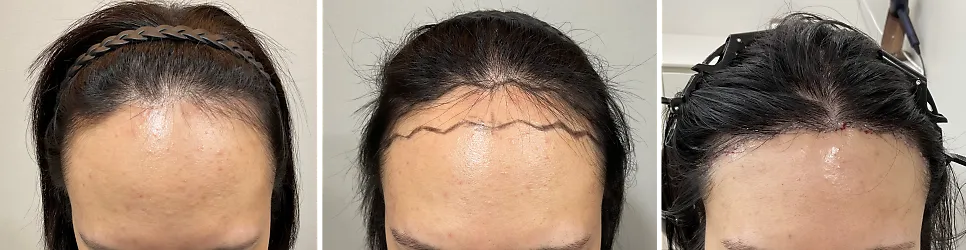
If only 2 cm had been lowered, then even if a hair transplant were done later, the height would have to be lowered again, and that would have required using even more follicles from the back of the head.
Two important points in forehead reduction surgery
So there are two key points in forehead reduction surgery. First, pre-surgery diagnosis is important, including elasticity checks and hair density assessment to determine how much the forehead can be lowered. Second, during surgery, skill is needed to lower the height as much as elasticity allows.
If the height is not lowered enough in the first surgery, the patient ends up going through trouble they did not need to. That should not happen.


