
By Dr. Park Sooho · 2024.01.14
Follicular units and hair count
If you have been consulting about a hair transplant, you may have been confused because there are two ways to calculate the number of hairs needed for transplantation.
The two ways are calculating by follicular units or by hair count. Let us look at the illustrations to understand how follicular units and hairs differ.
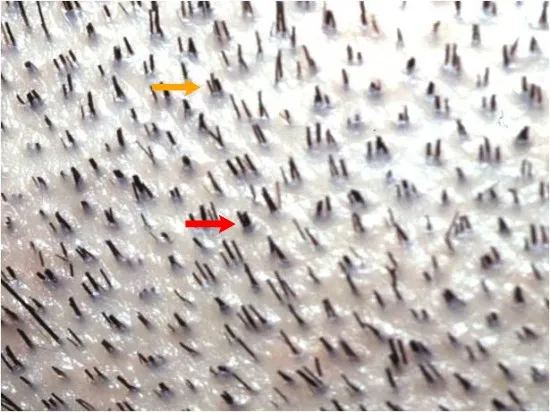
In the photo above, you can see hairs emerging two at a time (red arrows) or three at a time (yellow arrows); that is a follicular unit. A follicular unit may consist of just one follicle, two follicles, three follicles, or, very rarely in Koreans, four follicles.
When we consult, people often say 'follicle count,' but strictly speaking it should be 'follicular units,' because only one hair comes out of each follicle.
Looking again at a cross-sectional illustration, it is as follows.
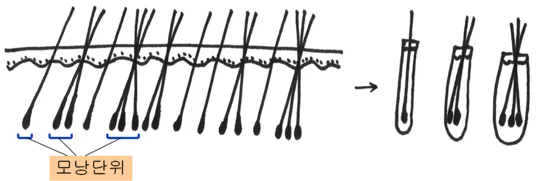
Because separating and transplanting by follicular unit gives the most natural results, nearly all clinics these days perform follicular unit transplantation.
Calculation methods differ by country
When calculating the amount needed for transplantation, most countries other than Korea use follicular units. I am not entirely sure why, but I think it may be because, in Western cultures where services are generally charged by time, surgery fees are set in proportion to the time required, whether for a single-follicle unit or a three-follicle unit.
In Korea, most clinics have used hair count. I think this is because in Korea, where results are valued, what ultimately matters to both sides is how many hairs were transplanted rather than how much time it took, so it was easier for everyone to understand.
In Korea too, as non-incisional harvesting has become more common, more clinics have started using follicular units. This is likely because with non-incisional harvesting, the time required differs considerably depending on the number of punches. So it is inevitable that patients feel confused.
Follicular units and hair count during harvesting
When harvesting non-incisionally, we mainly harvest two- or three-follicle units, because harvesting single-follicle units is inefficient. Allowing for follicles that get cut during harvesting, I usually explain in consultations that 1 follicular unit = 2 hairs (1,500 follicular units = 3,000 hairs). In general, it is actually more than 2 hairs per follicular unit.
However, if the doctor is not experienced, they might harvest 1,500 follicular units and end up with only 1,500 hairs. In that case, the picture is quite different.
Why calculating transplantation by follicular units becomes unclear
Assuming an experienced doctor, calculating harvested hair count by follicular units does not deviate much from the formula above, but calculating transplantation by follicular units does create some ambiguity.
Korean hair is thick, so if two- or three-follicle units are planted, the density may look good but often appears unnatural. In such cases, the harvested two- or three-follicle units are separated again into single hairs and planted. This is especially so for female hairlines.
When we need to correct a female hairline including the sides (sideburns), the proportion of single-follicle units can exceed 70%. When 3,000 hairs are harvested, calculating by the formula (1 follicular unit = 2 hairs) means about 1,500 follicular units are transplanted. But if 70% is separated into single hairs and transplanted, that becomes 2,100 single-follicle units plus 450 two-follicle units = 2,550 follicular units. The doctor has to transplant about 1,000 more grafts, and it takes much longer.
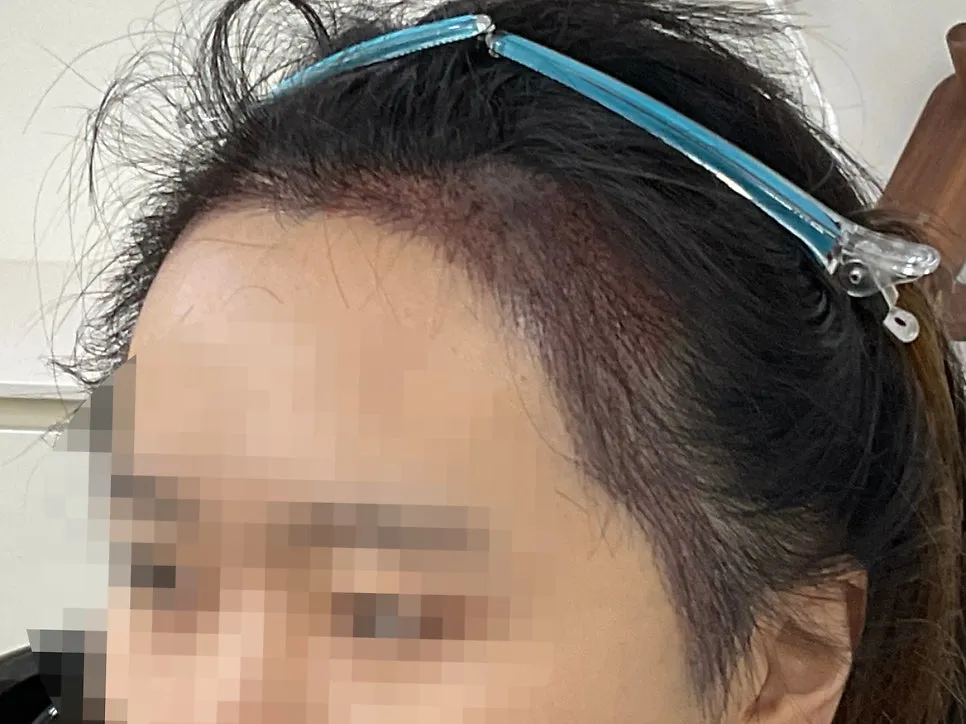
The photo above shows a female hairline corrected including the sides, right after surgery.
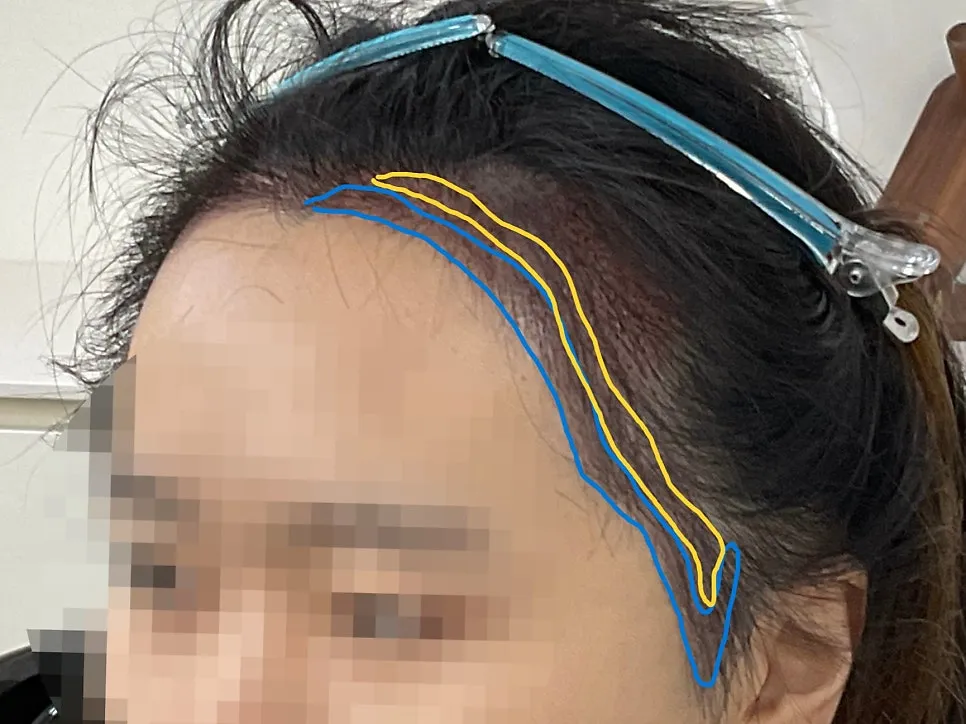
The areas marked with blue lines are all planted with single hairs. The yellow-line areas are given a gradation by mixing single hairs and two-follicle units, and the areas behind them are planted with two-follicle units, so many single hairs are inevitably needed.
Why we use only hair count
Calculating by hair count is simpler, since there is only one method regardless of how many punches were made during harvesting, how many follicles were cut, or how many single hairs were separated. After all, because hair count is more accurate than follicular units for predicting post-surgery results, we use only hair count, not follicular units, whether incisional or non-incisional.
Female hairline surgery costs somewhat more than male hair transplantation, because many single hairs must be planted to achieve a natural result. Even so, it is not expensive relative to the additional time it takes.
Conclusion: trust
Whether you calculate by follicular units or by hair count, there can be no single right answer.
The conclusion is that as long as enough explanation and trust is built between doctor and patient, either method should be fine. The right choice is to pick a doctor you trust and follow them without unnecessary doubt. And the doctor must not betray that trust.
※ Side effects such as swelling, inflammation, pain, and bleeding may occur after hair transplant surgery.


