
By Dr. Park Sooho · 2023.12.10
Why Transplanted Hair Grows Curly
Some people say that after a hair transplant, the transplanted hair grows in curly, wavy strands. Why is that? The exact cause is still not well understood.
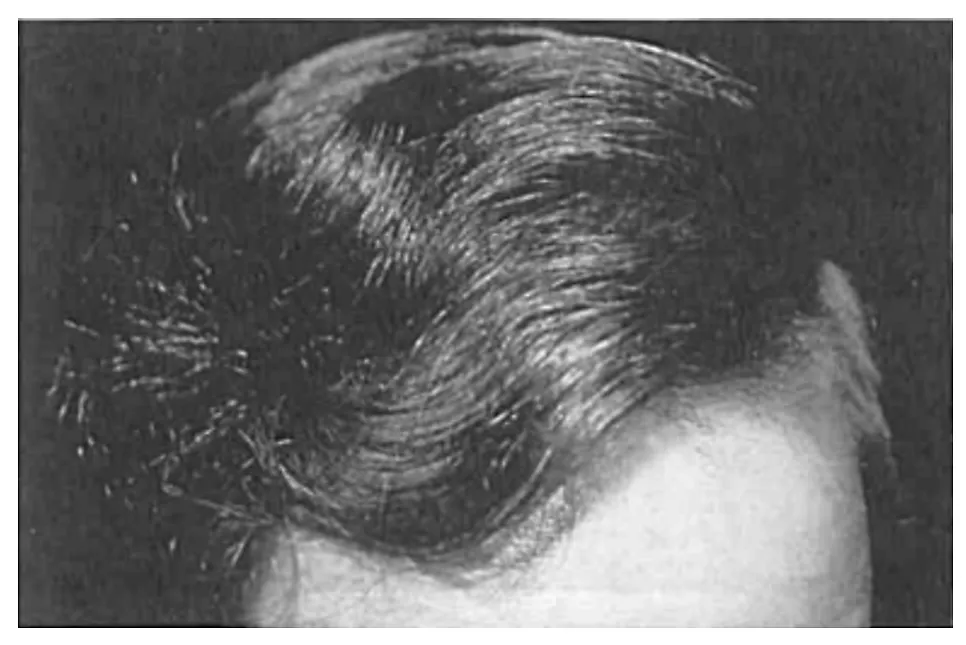
There are several hypotheses, and I will share the one I researched and presented. At the World Hair Transplantation Society congress held in Lisbon, Portugal, I also received a small award for this topic.
Transplanted Hair That Won't Take Dye and the Cuticle Layer
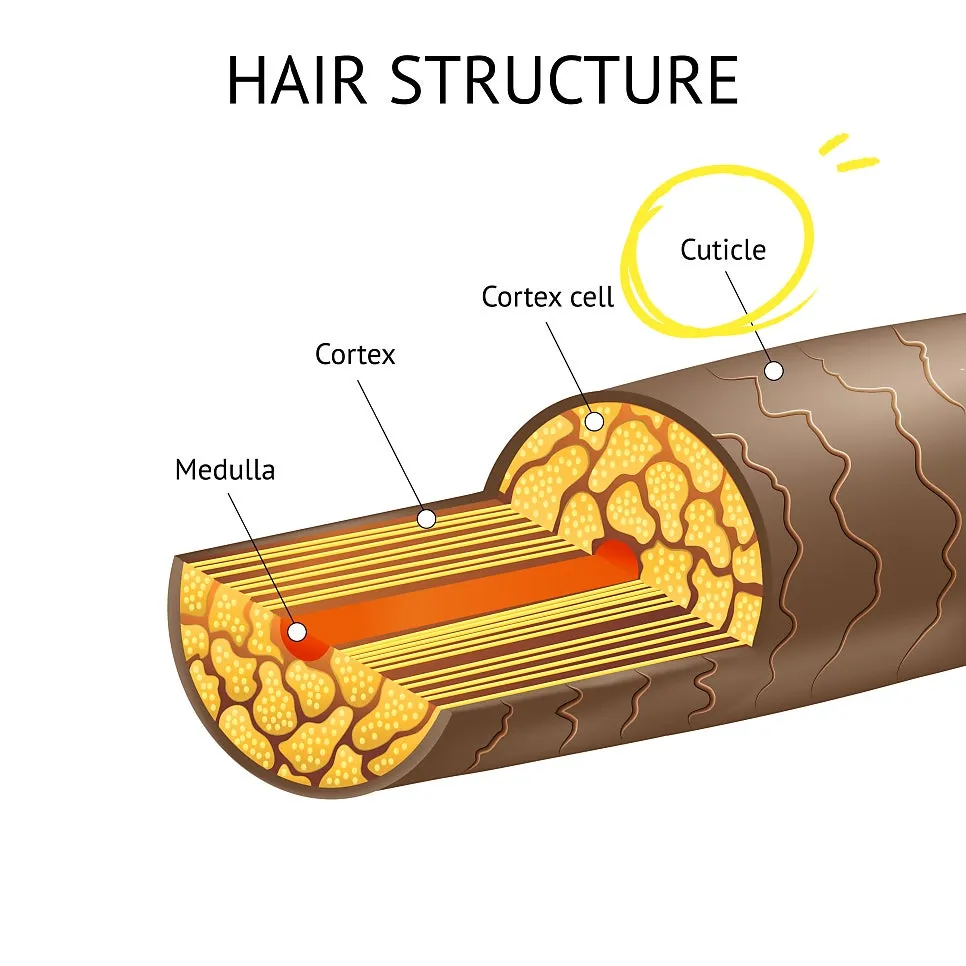
Some patients say after a hair transplant that the transplanted hair won't take dye, and their transplanted hair is often curly. If it won't take dye, I thought the cuticle layer might have changed, so I looked for papers. The cuticle layer is the outermost layer of the hair, covering it like scales.
There were papers on cuticle changes after hair transplant.
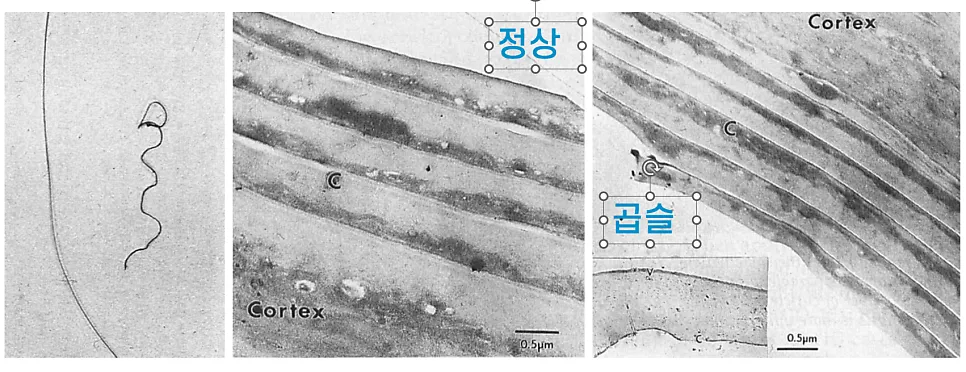
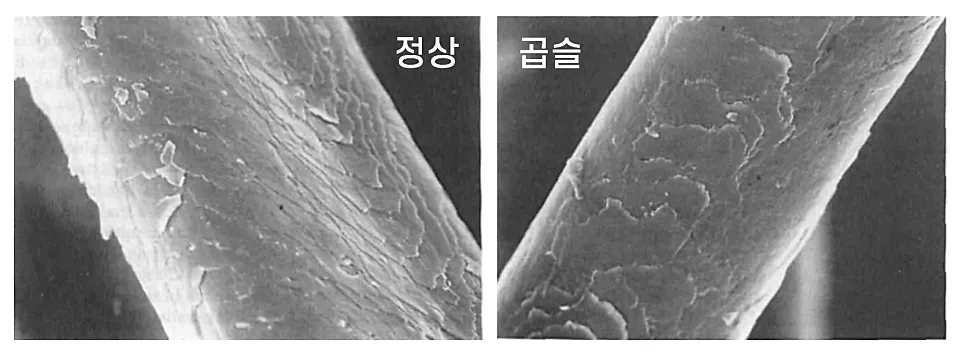
Observing curly transplanted hair under an electron microscope showed that the cuticle of the curly hair had irregular thickness and shape. However, the cause was still unknown, and the study concluded that further research was needed. So instead of the hair itself, I decided to look at the follicles under a microscope.
Follicles of Heavily Curled Hair Under the Microscope
Some people who have too low a density after a hair transplant want that area removed entirely. In such cases, we remove the skin of the transplanted area through forehead reduction surgery and lower the forehead height at the same time.
Just then such a patient came in, and I chose the heavily curled hairs among the sparse hairs in the transplanted area and looked at the scalp tissue under a microscope.
Because the father of Dr. Song, who worked with us at Mojerim Plastic Surgery, has long practiced skin pathology, we were able to study pathology we were not familiar with, and present the results in a presentation and a paper.
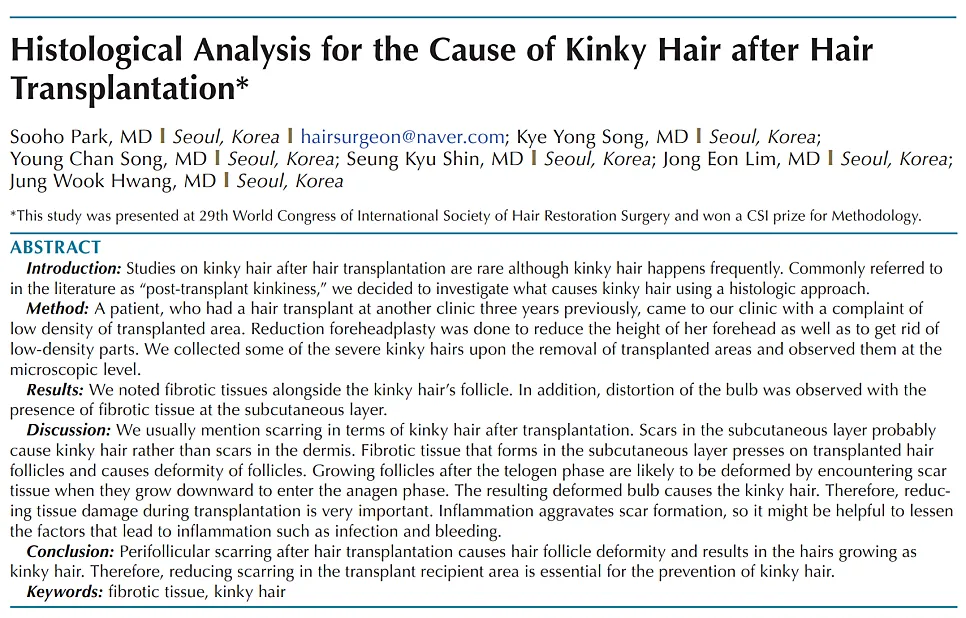
While listening to Professor Song's explanation, I also learned a lot about basic hair pathology. I would like to take this opportunity to thank Dr. Song and Professor Song once again. The image below is the abstract of the paper published in the World Hair Transplantation Society forum journal.
Follicle Squeezed by Scar Tissue
Let me show you the first hair with severe curls.
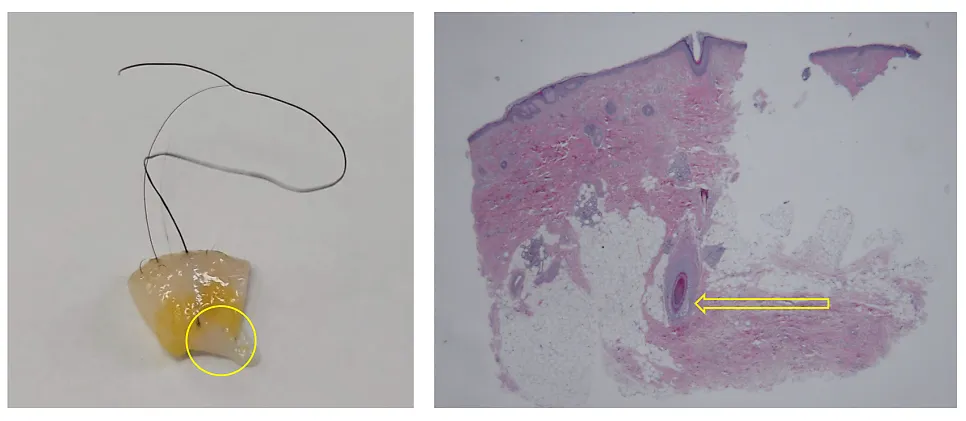
Under the follicle a white scar can be seen (yellow circle), and under the microscope the follicle appears pressed into red scar tissue (yellow arrow). Let me zoom in on the follicle.
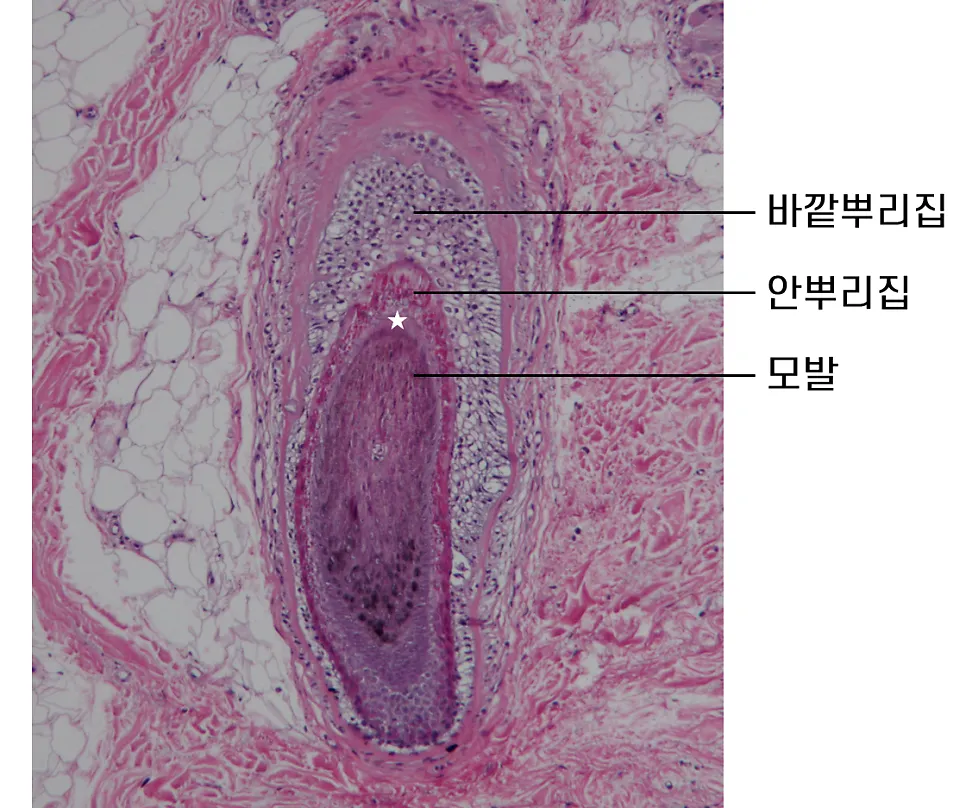
You can see the follicle squeezed into scar tissue. The white star marks the cuticle layer. At the lower level of the follicle it is bonded with the inner root sheath of the follicle; moving to higher levels, the follicle and hair separate, and it becomes what we commonly call the hair cuticle.
Normally, a follicle is surrounded only by fat tissue, as shown in the picture below, and its shape and the thickness of each layer are uniform.
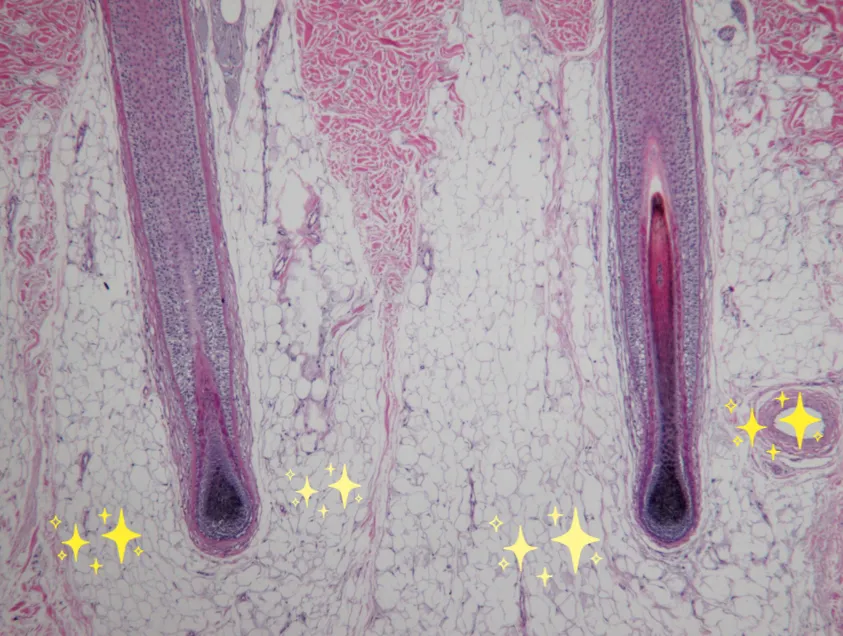
But when scar tissue presses on the follicle and deforms its shape, the shape and thickness of the cuticle layer are also deformed.
Follicles With and Without Curl
Let me show you one more photo.
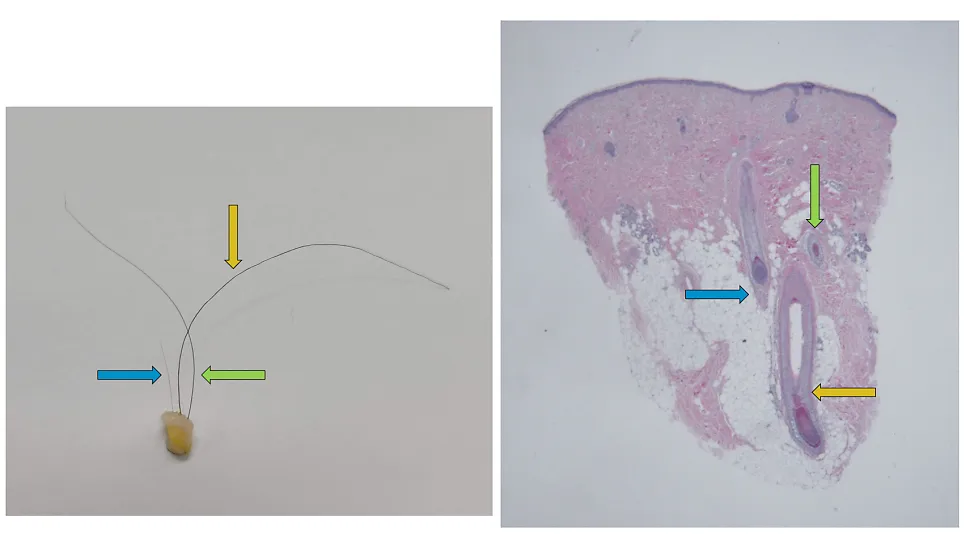
Here are the just-sprouting fine hairs (blue arrow), a hair without curl (green arrow), and a transplanted hair with curl (yellow arrow). The follicle of the curly hair is bent, while the follicle without curl keeps its round shape well. Let me zoom in further.
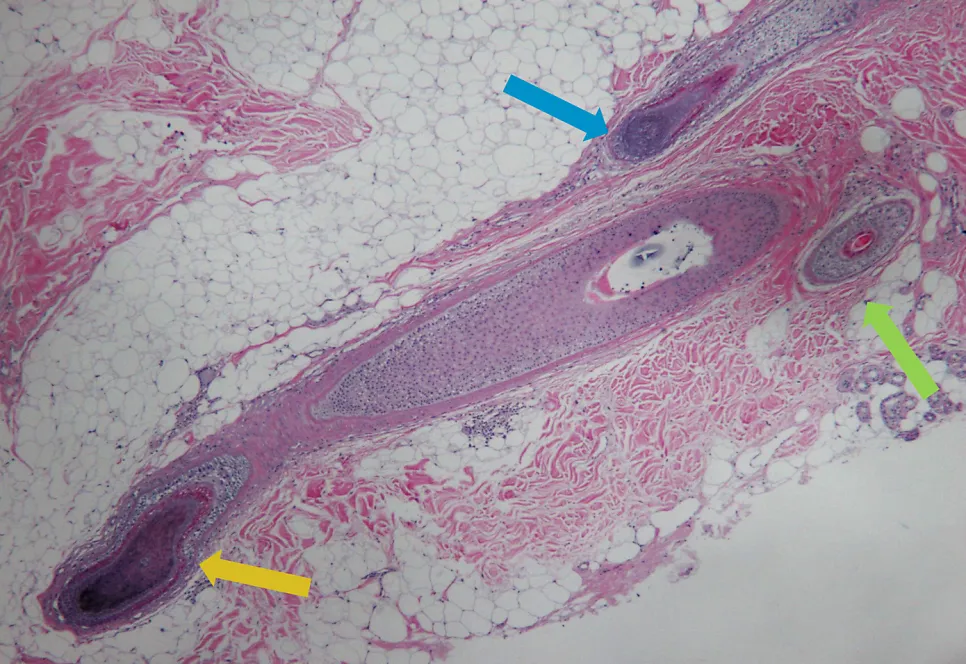
The difference in shape is clear. Let me show just one more.
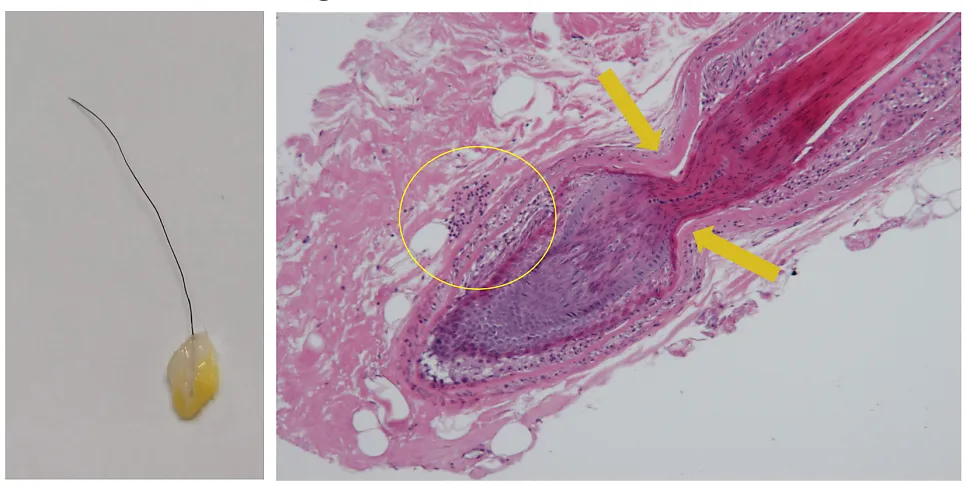
This is a severely curly hair. Even with the naked eye, white scars can be seen around the follicle. Under the microscope, the follicle is severely deformed. Several years have passed since the hair transplant, yet inflammatory cells can still be seen (yellow circle).
We also observed a hair among the transplanted ones that did not have curls.
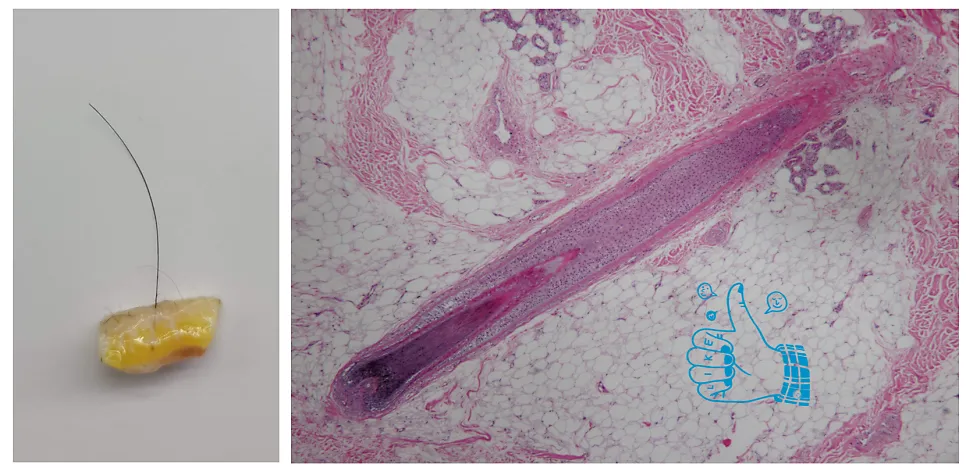
It maintains the normal shape of the hair as seen from above, without any change in shape. There is red scar tissue below the follicle, but fortunately it is somewhat apart from the follicle, so it did not deform the follicle.
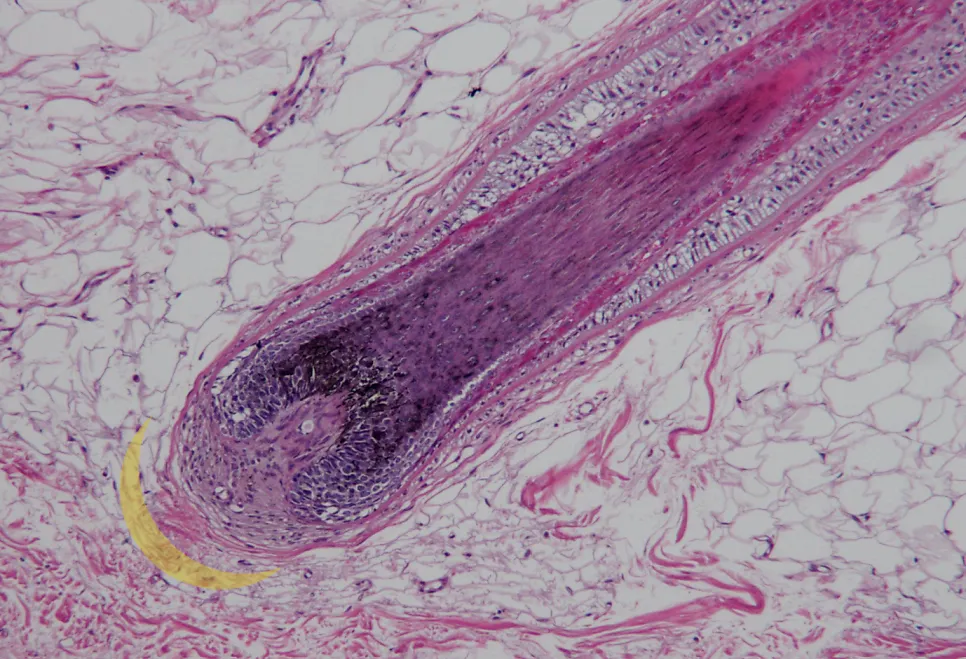
One Cause of Curls: Scar Tissue Around the Follicle
So I came to this conclusion: one reason curls form after a hair transplant is deformation of the cuticle layer. Deformation of the cuticle layer happens because the follicle is deformed. Deformation of the follicle is caused by scar tissue around it.
Other hypotheses include that the follicle bends into a 'J' shape during the transplant process, and that the transplanted follicle meets resistance as it pushes through scarred skin and bends as a result.
All of these are possible, but at least in this study, we learned that a cuticle layer deformed by the scar tissue around the follicles can cause curly hair after a hair transplant.
Curly hair after a hair transplant usually straightens out in most cases after 2 to 3 years, which is similar to the period when scar tissue softens again.
To reduce curls after a hair transplant, although there are individual differences between patients, I think it takes the experience and skill to minimize scarring. That may be the reason fewer people feel bothered by curls over time compared with when I first started hair transplants.


