
By Dr. Park Sooho · 2023.11.05
Incisional or Non-Incisional?
After deciding on a hair transplant, many people struggle with whether to choose incisional or non-incisional. Both incisional and non-incisional are excellent methods.
Either method is often fine, but depending on hair thickness or density, scalp elasticity, and degree of hair loss, one method may produce a better result.
We compared, in rough numbers from 100% to 0%, how often non-incisional is recommended in each situation. These figures are only to aid understanding and do not perfectly match reality.
When incisional is difficult
When scalp elasticity is insufficient, the probability of recommending non-incisional is 100%. If scalp elasticity is insufficient, large tension is placed on the closure after incision, which can cause severe pain, wide scarring, and skin necrosis, and it is also impossible to harvest a sufficient amount. Before surgery, elasticity must be checked accurately.
After multiple incisional surgeries, the probability of recommending non-incisional is 90%. If there are multiple scar lines or several incisional surgeries in one area, there is a high likelihood that there is not enough space or elasticity for another incision.
Incision is not impossible, but non-incisional is recommended in some cases
When there is fear of incision, the probability of recommending non-incisional is 80%. Some people have a vague fear of the word incision. Even when I explain thoroughly that it is a safe surgery, for those who are afraid of the idea of a knife being used on the head, I recommend non-incisional.
When you do not want a linear scar, the probability of recommending non-incisional is 70%. Incisional scars usually remain as fine linear lines and are not very noticeable, and even if the scar widens, it can usually be resolved with scar grafting. However, if you have an aversion to a linear scar itself, I recommend non-incisional, which leaves scars as multiple small dots.
When you are sensitive to pain, the probability of recommending non-incisional is 60%. After incision, a pulling pain lasts for a few days (usually a throbbing feeling in the scalp a few hours after tying the hair back or wearing a headband). For those who are sensitive to pain and anxious, I also recommend non-incisional.
Non-incisional also involves some pain, though relatively less than incisional. On the day after surgery, there is a stinging pain like when water touches a wound, and occasionally pain may last for several weeks. Some people also complain of severe pain after non-incisional surgery.
Non-incisional is fine, but incisional is recommended in some cases
When cost is a burden, the probability of recommending non-incisional is 50%. Because of the names incisional and non-incisional, many people prefer non-incisional. Each has its strengths and weaknesses, and both are good methods with no significant difference in surgical results. The reason non-incisional costs more than incisional is that harvesting takes longer in non-incisional surgery.
If you vaguely believe non-incisional is the superior method and want non-incisional surgery but are worried about the cost, I will explain incisional harvesting thoroughly and reassure you.
When a long surgery time is a burden, the probability of recommending non-incisional is 40%. For those who have back or neck problems, or who have difficulty lying face down for long periods due to breast surgery or other procedures, or due to claustrophobia or panic disorder, an incisional surgery with a shorter surgery time may be more comfortable.
When a large amount needs to be harvested, the probability of recommending non-incisional is 30%. For women with small head shapes, if a large amount must be harvested non-incisionally, follicles have to be taken densely from the whole back of the head. Those whose foreheads are wide enough to require a hair transplant with that large a hair count often want to narrow their foreheads even more after a successful first surgery.
However, if non-incisional harvesting has already been done densely across the whole back of the head, it is difficult to harvest again by non-incisional, so when the harvest volume is large relative to the head shape, I usually recommend incisional for a first surgery.
When non-incisional is not a good fit
When hair is fine and you feel you have thin hair, the probability of recommending non-incisional is 25%. If the hair density is normal but the hair shafts are fine, the back of the head may look flat when the hair is tied back, because the volume at the back of the crown is lacking. Incisional can harvest only from the lower part of the back of the head, so it can preserve the volume at the upper back of the head. Non-incisional harvests from the entire back of the head, so the upper volume is inevitably reduced.
When the density at the back of the head is low, the probability of recommending non-incisional is 20%. When hair is harvested non-incisionally, the distance between the remaining hairs on either side of the harvested hairs stays the same, so the gaps between the remaining hairs become about twice as wide. For those who originally had good density it does not matter, but for those with lower density, the scalp may show through after non-incisional harvesting. Incisional increases the gaps between the remaining hairs ‘uniformly’ (about 10%), even when harvesting the same amount, so the scalp shows through less.
For a first surgery for female-pattern hair loss, the probability of recommending non-incisional is 10%. Female-pattern hair loss, unlike male-pattern hair loss, affects hair across almost the entire scalp. Even so, the middle part of the back of the head, which is a safe zone, is relatively less affected. Using hair from the safe zone increases the likelihood that transplanted hair survives longer. Non-incisional inevitably goes outside the safe zone, while incisional can harvest within it.
When non-incisional is not possible
If you have had multiple non-incisional surgeries, or if a large-volume transplant by non-incisional has already been performed and the spacing between hairs is already wide, the probability of recommending non-incisional is 0%. In such cases, additional non-incisional harvesting would make the scalp at the back of the head show through.
If you harvested every other hair in the first surgery, the spacing between the remaining hairs doubles. If you harvest every other hair again in a second surgery, the spacing between the remaining hairs widens fourfold and the scalp shows through considerably. Also, non-incisional harvesting mainly takes 2- or 3-follicle units, so only single-follicle units are left behind.
You do not need to give up either scissors or a knife
It is true that the non-incisional method was developed later than the incisional method, as a newer approach. However, that does not make non-incisional superior to incisional. They are complementary methods, each with its own strengths and weaknesses, and you can get a better effect by choosing wisely according to the situation. If you insist on only one method, you give up one excellent option.
The purpose of cutting something is the same, but sometimes scissors are more convenient and sometimes a knife is. You do not need to give up either one.
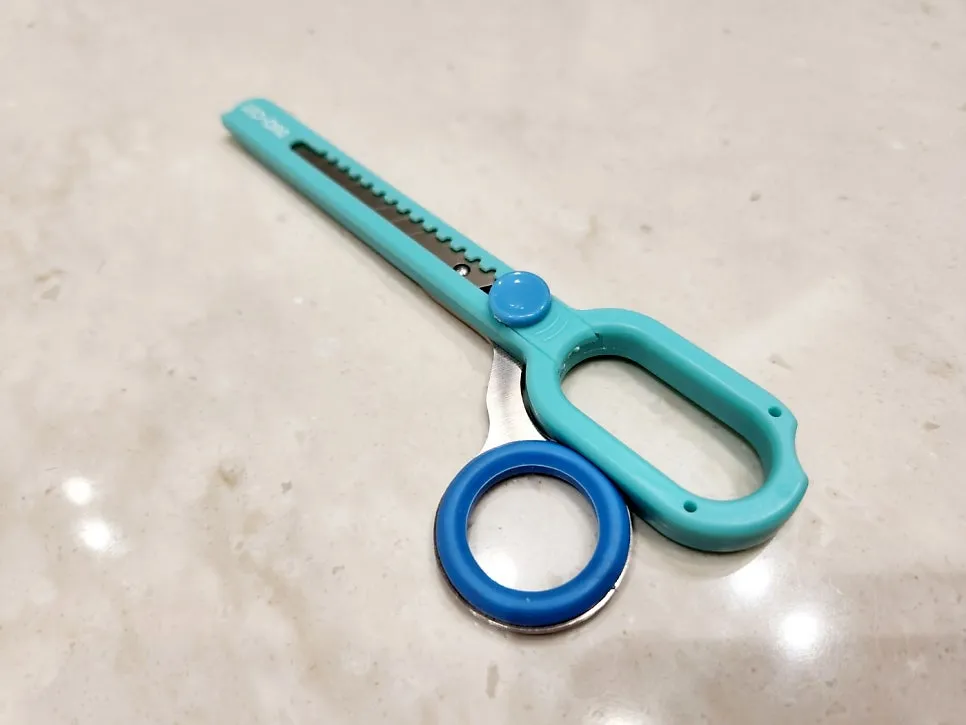
Epilogue
The scissors-and-knife combination in the photo above holds a memory for me. In middle school, I entered the same idea in a school invention competition. I have always enjoyed making things, and since sometimes scissors are convenient and sometimes a knife is, I thought it would be nice to use both at once. I found a knife and scissors of the right size and glued them together to make a prototype.
I nervously took my idea notebook and prototype to the teacher in charge in the teachers’ office. The teacher let out a half-laugh, tossed them into a desk drawer, and told me to go along. I remember being quite disappointed, as a young child who had hoped for at least a word of praise for a good idea, even if I did not win an award.
When I saw this idea turned into a product more than ten years later, I felt both joy and regret. The lesson I learned is that ‘the person who actually puts an idea into practice and produces results is the real one.’ That is a happy ending.


